Renting to traveling nurses means leasing a furnished unit to a healthcare professional on a temporary hospital assignment, usually for one to six months. Most hospital contracts run 13 weeks, and nurses arrive with a housing stipend that sets their budget. It sits in the mid-term rental category, between a nightly Airbnb stay and a standard 12-month lease.
For landlords with a vacant unit or an underperforming long-term rental, travel nurse housing can fill gaps in occupancy with tenants who are pre-vetted by staffing agencies and paid on a predictable schedule.
Key Takeaways
|
What Traveling Nurses Need in Rent

Travel nurse rental requirements and housing needs (Source)
Traveling nurses are registered nurses who take short-term assignments through a staffing agency. They fill gaps at hospitals facing seasonal surges, staff leave, or chronic understaffing. They relocate every few months. That makes their housing needs different from a typical annual tenant.
Traveling nurses need a furnished, move-in-ready unit. It has to match the length of their hospital contract. The average travel nurse contract runs about 13 weeks, or just over three months. Some facilities offer 8-week terms. Others stretch to 26 weeks.
Most travel nurses are looking for:
- A furnished rental with basic furniture, kitchenware, and linens already in place
- Utilities-included rent so they don't have to open and close accounts every quarter
- A location within a reasonable commute of the assigned hospital
- A lease term that matches or slightly exceeds their contract length
- Reliable Wi-Fi, since many nurses handle scheduling, licensing, and continuing education online
- Flexibility if a contract is extended, shortened, or canceled by the facility
Landlords who understand these priorities can position a property as travel nurse housing rather than compete in the standard long-term rental pool. For a broader look at how this rental category works, see LeaseRunner's guide on what a mid-term rental is.
What Are the Pros and Cons of Renting to Travel Nurses?
Renting to travel nurses offers higher monthly income potential but comes with more operational work than a standard lease. The trade-off comes down to rent premiums and steady demand versus furnishing costs and more frequent turnover.
The Pros
- Higher monthly rent. A furnished unit priced for a housing stipend often earns more per month than an unfurnished long-term unit in the same building.
- Reliable, verifiable income. Travel nurses are employed by staffing agencies or hospital systems. That makes income verification more straightforward than with many short-term renters.
- Steady inquiry flow near major medical centers. Hospitals near major medical centers have a steady rotation of incoming nurses, which keeps qualified applicants coming in.
- Built-in tenant turnover cycle. Leases are shorter, so a problem tenant is out sooner than in a 12-month lease.
The Cons
- Furnishing and setup costs. Beds, kitchenware, and a full furnished unit inventory require upfront investment before the first tenant moves in.
- More frequent turnover. Even a strong 13-week cycle means cleaning, restocking, and re-listing several times a year.
- Local regulation risk. Some cities treat mid-term rentals under a certain length as short-term rentals. A local short-term rental ordinance can require permits, taxes, or occupancy caps. Rules vary widely by jurisdiction, so check local ordinances before listing.
- Income can fluctuate with hospital staffing cycles. Demand for travel nurses shifts with flu season, hospital census, and regional nursing shortages. Occupancy isn't guaranteed year-round. Outside those markets, or off-season, gaps between contracts can stretch to weeks.
How Much Can You Charge?

Travel nurse rental pricing and monthly rent (Source)
You can typically charge more for a furnished unit than an unfurnished one. But the tenant's housing stipend sets a hard ceiling on what's realistic, not a number to hit automatically. Most staffing agencies pay travel nurses a taxable hourly wage plus a separate housing stipend. That stipend is capped by U.S. General Services Administration (GSA) per diem lodging rates for the assignment's location.
Fiscal Year 2026 runs from October 1, 2025, through September 30, 2026. Under GSA Per Diem Bulletin FTR 26-01, the standard CONUS (continental U.S.) lodging rate for that period is $110 a day, unchanged from FY2025. Agencies typically offer stipends at or slightly below the GSA maximum for the assignment city. (Source: GSA Per Diem Bulletin FTR 26-01)
Actual weekly housing stipends vary a lot by metro area. They generally run $700 to $1,600 a week. The exact number depends on the assignment's cost of living and local GSA rates. Higher-cost markets like California and New York sit at the top of that range.
|
Market Type |
Typical Weekly Housing Stipend Range |
|
Lower-cost metro or rural hospital market |
700 - 1,000 |
|
Mid-size metro |
1,000 - 1,300 |
|
High-cost coastal metro (e.g., Los Angeles, San Francisco, NYC) |
1,300 - 1,600+ |
Source: GSA Per Diem Bulletin FTR 26-01; Vivian Health, "How Travel Nurse Housing Stipends Work"
Translated into monthly numbers, that range runs from roughly $3,030 a month at the low end to $6,930 a month at the high end, using a standard 4.33-week month. A landlord in a mid-size metro pricing a unit against a $1,100-a-week stipend, for example, is really pricing against a budget of about $4,760 a month. That's the number to compare against your actual furnished-unit costs, not the weekly headline figure alone. (Source: GSA Per Diem Bulletin FTR 26-01)
The stipend cap traces back to the IRS tax home rule. To receive housing and meal stipends tax-free, a travel nurse generally must maintain a permanent "tax home" elsewhere. They also have to show they're paying for temporary lodging away from it. That's part of why nurses need a real, documented lease, not an informal arrangement. (Source: IRS Publication 463 (current edition))
Here's a practical way to price a unit for renting to traveling nurses. Check the GSA per diem lodging rate for your city. Multiply the daily rate by seven. That gives you the weekly housing budget most nurses in that market will have. Treat that number as your ceiling, not your default price. A basic studio and a fully renovated two-bedroom near the same hospital share the same stipend ceiling, but they shouldn't share the same rent — set the actual number based on your unit's size, condition, and what comparable furnished rentals nearby are charging. Pricing above the local GSA rate doesn't disqualify your listing. But it puts you outside what most stipends will comfortably cover. This framework applies beyond travel nurse tenants, too. See LeaseRunner's guide on how much rent to charge for more.
How to Rent to Traveling Nurses (Step by Step)
Renting to traveling nurses takes more than listing a property and waiting for applicants. Six steps can help you prepare your rental, set the right price, market it effectively, and screen tenants with confidence. Most landlords who struggle skip step 1 or step 5, which can lead to vacancies or poor tenant matches.
Confirm local demand
Confirm demand by checking your property's distance from a hospital or medical campus with active travel nurse contracts. Properties within 15 to 20 minutes of a major hospital, teaching hospital, or trauma center see the steadiest inquiries. Nurses want a short commute around 12-hour shifts. Search local hospital job boards and travel nursing agency listings for your metro. That tells you how many open contracts currently exist nearby.
Prep & furnish the unit

Furnished rental preparation for traveling nurses (Source)
Prep the unit by furnishing it completely. Travel nurses aren't bringing furniture for a three-month stay. Before listing, work through this prep checklist:
Clean & test
- Deep-clean the entire unit
- Test appliances and major systems
- Check locks and smoke detectors
- Check lighting fixtures and replace any dead bulbs
Furnish & stock
- Provide a comfortable bed, mattress, and adequate storage
- Stock the kitchen with basic cookware, utensils, and dishware
- Add linens and towels
- Confirm reliable internet service is active
- Add blackout curtains or blinds, since many tenants sleep during the day on night shifts
Document & set rules
- Photograph every room accurately before listing
- Document existing damage and create a signed furnished-item list at move-in
- Write clear house rules
- Confirm utility arrangements and any usage caps
- Make parking rules clear
- Prepare emergency and maintenance contact information
The goal is simple. The tenant should arrive with personal belongings and start living in the property. They shouldn't need to buy basic household items. For a cost and appeal comparison, see LeaseRunner's breakdown of furnished apartments vs. unfurnished.
Price to the stipend
Price the unit against the GSA lodging rate for your city as a ceiling, not against standard long-term comps. Then set the actual number within that ceiling based on your unit's size, condition, and what comparable furnished rentals nearby are charging, the same way you'd price any other rental. Include utilities in the quoted rent whenever possible. Travel nurses strongly prefer one all-in monthly number. They want to compare it directly against their stipend, rather than opening separate utility accounts for a three-month stay.
List on niche channels
List your rental on platforms built for mid-term and healthcare housing, not just standard vacation-rental sites. Targeted channels put your listing in front of nurses actively searching for 13-week stays.
Useful channels for renting to traveling nurses include:
- Furnished Finder: The largest furnished-housing marketplace for traveling professionals. Most of its traffic comes from travel nurses and other healthcare workers, though other traveling professionals also use it.
- Travel Nurse Housing and Transplant Housing: Smaller, niche sites built specifically around healthcare travelers and their 13-week contract cycles.
- Airbnb and VRBO: Set minimum-stay requirements of 30 days or more to reach travel nurses. In many jurisdictions, a 30-day-plus stay is exempt from local transient-occupancy or short-term rental taxes. The exact threshold varies by city and state, so confirm the rule where your property is located.
- Direct hospital housing boards: Contact human resources or staffing coordinators at nearby hospitals about listing your property directly with them.
Screen for affordability
Screen every travel nurse applicant the same way you would any other tenant. Use standard background and income checks, not assumptions based on the profession. At minimum, request:
- Proof of income: the agency employment contract, recent pay stubs, a bank statement, or a W-2 from the staffing agency
- Background check: a nationwide criminal and eviction history report through a secure tenant background screening provider
- Credit check: a soft-pull credit check that confirms financial responsibility without affecting the applicant's credit score
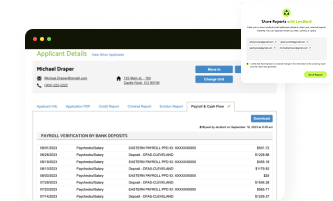
An income verification and cash flow report checks this for you. It confirms that the stipend and wages on a pay stub match what's actually landing in the bank each month. LeaseRunner's guide on how landlords verify employment covers the documentation request process in more detail. Some travel nurses contract independently instead of through an agency. For that smaller group, LeaseRunner's self-employed proof of income guide is a useful reference.
Use a flexible short-term lease
Put the lease in writing. Build it specifically for a mid-term stay, not a verbal agreement or a daily vacation-rental contract. A written agreement should spell out deposit handling and cancellation procedures up front. That way, both sides know what happens if the hospital contract changes.
What Lease Terms Work for Travel Nurses?
The lease terms that work best for travel nurses mirror the length and uncertainty of their hospital contract rather than a standard annual lease. Below are the components landlords typically need to adjust.
Term length
A fixed-term lease of three to six months generally fits a standard 13-to-26-week travel nurse contract better than a full-year term. Some landlords use a month-to-month lease instead, especially when a nurse's exact end date is uncertain, though this trades some income predictability for flexibility.
If the nurse's assignment is shorter or longer, adjust the fixed period accordingly. For details on structuring custom timelines, review what is lease length.

Travel nurse lease term length for mid-term rentals (Source)
Early-termination / flexible cancellation
An early-termination clause for travel nurses should require written notice, typically 14 to 30 days. It should also require proof of the hospital contract cancellation. Hospital staffing needs can change without warning. A rigid early-termination penalty can deter otherwise qualified applicants.
Consider adding a lease addendum for this. If the hospital cancels the contract, the lease can end early on written notice. The tenant forfeits only the pre-paid rent for the notice period.
Security deposit
Collect the security deposit the same way, and at the same general level, you would for any other tenant. State law on deposit caps, timelines, and itemized return requirements applies regardless of lease length. Security deposit rules vary significantly by state. Confirm your specific state's cap and return-timeline requirements before setting the amount.
Furnished-unit lease specifics
Attach a signed furniture inventory to the lease at move-in. List every major item and its condition. This protects your investment in furniture and appliances. It also gives both parties a clear reference point at move-out.
A few clauses worth including in the addendum:
- Utility caps: a reasonable ceiling (for example, $150 a month for electricity) above which the tenant pays the difference
- Housekeeping expectations: basic maintenance standards during the stay
- Pet policy: state your policy clearly, but don't treat this area as settled. A May 2026 HUD enforcement memo means HUD's own fair housing office will generally decline to pursue federal complaints over untrained emotional support animals, borrowing the ADA's "individually trained" requirement without adopting the ADA's dogs-only rule. That's a change in how HUD enforces, not a change in the law: Congress hasn't amended the Fair Housing Act, the statutory definition of disability and the duty to provide a reasonable accommodation are still in force, and a tenant can still sue a landlord directly in federal or state court, where a judge — not HUD's enforcement guidance — decides what counts as reasonable. State and local ESA protections are also unaffected. Treat the memo as a lower chance of a HUD complaint, not a green light to deny ESA requests outright, and confirm your state's rules before changing your policy (Source: HUD FHEO Enforcement Guidance – Assessing Requests for the Use of an Animal as a Reasonable Accommodation Under the Fair Housing Act, May 22, 2026)
Renewal path
A renewal clause should let the tenant extend in short increments. Hospital contract extensions are often granted in blocks of a few weeks, not a full additional year. Agree on an extension rate at signing. That removes the need to renegotiate rent every time an assignment is extended.
Is Renting to Travel Nurses Worth It?
Renting to travel nurses is often worth it near active hospital systems. You need to absorb the furnishing cost and handle more turnover, though. It isn't a fit for every property or every owner. Metro areas with multiple hospitals, teaching facilities, or trauma centers tend to work best. A steady pipeline of incoming nurses lowers vacancy risk there. Markets with just one small hospital favor landlords less, since demand may be seasonal or thin.
Owners who want minimal turnover and hands-off management may prefer a standard 12-month lease, even at a lower rate. Owners willing to furnish a unit, screen tenants every few months, and market through nurse-specific channels can often earn more than long-term rent. This is especially true in high-stipend metro markets. An independent landlord should weigh the extra work against a property manager's fee first.
Conclusion
Renting to traveling nurses can be a practical mid-term rental strategy for landlords with well-located, furnished properties. Price the unit against local stipend data. Screen every applicant consistently. Use lease terms built around the realities of a temporary hospital assignment. Get those three pieces right. A furnished unit near an active hospital can turn a slow-moving vacancy into steady, well-documented income.
LeaseRunner can simplify the landlord side of this process. Use its tools for tenant background screening, credit checks, and income verification to screen and lease your furnished rental with less back-and-forth.
FAQs
Are travel nurses good tenants?
Travel nurses are generally reliable tenants. Their income comes from a staffing agency or hospital system with a documented contract. That makes income verification more straightforward than with many other short-term renters. As with any tenant, reliability still depends on the actual screening results. That means a credit check and background report, not the profession alone.
How long do travel nurses rent for?
Most travel nurses rent for the length of a single hospital contract, typically 13 weeks. Some assignments run as short as 8 weeks. Others extend to 26 weeks. (Source: CoreMedical Group industry data)
Do I still need to screen travel nurses?
Yes. A staffing agency verifies clinical credentials. It doesn't screen for rental risk factors like past evictions, low credit scores, or missed payments. Run the same income, credit, and background checks you would use for any applicant.
Do travel nurses want furnished rentals?
Yes. Most travel nurses specifically look for furnished rentals, since they aren't relocating permanent furniture for a three-to-six-month assignment. A fully furnished unit with utilities and internet already active is one of the top filters travel nurses use. It's usually the first thing they check when comparing mid-term housing.
Disclaimer: The information provided in this post is intended for general informational and educational purposes only. It should not be construed as legal, accounting, or tax advice. For guidance specific to your situation, we recommend consulting with a qualified professional in the relevant field before taking any action based on the content provided.