Self employed proof of income refers to the official financial records that demonstrate how much a self employed, freelance worker, independent contractor, business owner, or sole proprietor earns over a consistent period of time. Landlords require reliable documentation because rental qualification depends on stable, verifiable earnings, not job titles.
Unlike W-2 employees who present a simple pay stub, self-employed applicants must assemble a package of tax and financial documents. Accurate self employed income verification protects landlords from default risk and ensures compliance with fair housing and screening standards.
What is Self-Employed Proof of Income?
Self employed proof of income is documentation that verifies earnings generated from business activity rather than traditional employment. The documents confirm income consistency, income amount, and income source.
The self employment income definition includes revenue earned through business ownership, contract work, freelance services, consulting, farming, or rental operations. Income flows from clients or customers instead of a payroll department.
Landlords evaluating proving income self employed typically review:
- Annual tax returns (form 1040)
- Schedule C / Schedule E / Schedule F
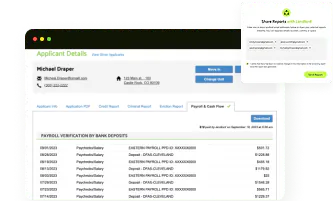
- Bank statements
- Profit and loss statement
- Self-generated pay stubs
- Invoices / client contracts
Each document serves a distinct purpose:
- Tax returns confirm historical income.
- Bank statements confirm cash flow.
- Profit and loss statements confirm current performance.
- Contracts confirm future income stability.
For landlords asking how to verify income for self employed, the answer requires layered documentation rather than a single form.
Key Documents for Self-Employed Income Verification to Rent Apartment
Landlords reviewing how to prove income for apartment applications expect structured, consistent financial proof. A complete verification package reduces disputes and speeds up approvals.
1. Tax Returns (Form 1040 and Schedule C)
Tax returns provide the strongest long-term verification of self-employed income. A complete tax return includes form 1040, which reports total income, and attachments such as:
- Schedule C (profit or loss from business)
- Schedule E (supplemental income, including rentals)
- Schedule F (farm income)
A business owner or sole proprietor typically reports net profit on Schedule C. Net profit after expenses appears on line 31 of Schedule C and transfers to Schedule 1, then to form 1040.
Landlords analyzing is verifiable monthly income gross or net should rely on net income. Net income reflects actual available funds after expenses. Gross income may overstate financial capacity when business expenses are significant.
For rental screening purposes:
- Most landlords request the last two years of annual tax returns (form 1040).
- Consistency across years signals income stability.
- Declining revenue trends raise risk concerns.
Regarding can I use my tax return as proof of income, the answer is yes. A signed and filed tax return qualifies as official income documentation. However, tax returns show past performance, not necessarily current income strength.
2. 1099 Forms (1099-NEC, 1099-MISC)
1099 forms verify income paid by clients to independent contractors. An independent contractor or freelance worker receives:
- 1099-NEC for nonemployee compensation
- 1099-MISC for certain miscellaneous payments
A 1099 confirms gross income paid by a specific client during a tax year. However, 1099 forms do not show expenses. Therefore, 1099 forms alone do not confirm net income.
When evaluating what is evidence of income for self-employed people, landlords should treat 1099 forms as supplemental documentation. Strong verification combines:
- 1099 forms
- Schedule C
- Supporting bank statements
Consistency between 1099 totals and Schedule C gross receipts increases credibility.
3. Bank Statements (Personal and Business)
Bank statements provide a real-time look at cash flow and are often required to supplement a tax return that may be several months old. For a business owner, showing 12 to 24 months of consistent deposits serves as a vital way of how to show proof of self-employed stability.
Landlords often look for:
- Regularity of deposits from clients.
- Average ending balances.
- Separation between business and personal expenses.
If an applicant struggles with how to rent an apartment without credit, strong bank statements showing significant cash reserves can mitigate the landlord's risk.
4. Profit and Loss (P&L) Statements (Year-to-Date)
A profit and loss statement shows current business performance.
A profit and loss statement summarizes:
- Revenue
- Cost of goods sold
- Operating expenses
- Net income
For landlords evaluating how to show proof of self-employed income, a year-to-date P&L fills the gap between the last tax return and the present month.
However, a P&L prepared by the applicant requires cross-verification. Landlords should match reported revenue with:
- Bank deposits
- 1099 totals
- Client invoices
When prepared by a CPA, a P&L carries stronger credibility.
5. Invoices and Contracts (Active Work and Steady Income)
Invoices and contracts demonstrate ongoing business relationships.
Invoices / client contracts confirm:
- Active engagements
- Recurring billing
- Contract duration
- Payment frequency
For example:
- A consulting contract paying $5,000 monthly for 12 months shows stable forward-looking income.
- A freelance design agreement paying per project signals variable revenue.
Landlords assessing how to verify income for self employed should prioritize recurring contracts over one-time invoices.
6. Additional Documentation
Additional supporting documents strengthen verification:
- Self-employed proof of income form signed by CPA
- Business license
- Articles of incorporation
- Prior lease payment records
- Reference letters
Landlords may also request a landlord referral letter to confirm payment history. When rent denial occurs due to insufficient documentation, federal law under the Fair Credit Reporting Act (15 U.S.C. § 1681m) requires landlords to issue proper notice. Landlords can review compliance steps in this guide to what to include in an adverse action letter.
Tips for Keeping Your Income Records Organized

Organized records make self employed income verification faster, clearer, and more credible. A landlord reviewing self employed proof of income looks for consistency and traceable documentation. Structured financial habits create that consistency.
Separate Personal and Business Finances
Separate accounts simplify self-employed proof of income by isolating professional revenue from personal lifestyle spending. How to show proof of self-employed stability starts with opening a dedicated business checking account and using it exclusively for business transactions.
This setup provides:
- Clean revenue tracking: Every deposit is identifiable as business income.
- Clear expense separation: Business deductions are not buried under grocery or utility bills.
- Accurate net income calculation: Landlords can easily verify the "bottom line" without manual adjustments.
A business owner using mixed accounts increases review complexity, often leading to delays in the tenant background screening process.
Schedule "Money Dates"
Monthly financial reviews prevent surprises and ensure that evidence of income for self-employed people is always current. To make this work, an independent contractor should block one hour on the last Friday of every month to perform a "Money Date." During this session:
- Income tracking: Log all payments received against open invoices.
- Expense categorization: Label every transaction as a specific tax-deductible category.
- Invoice follow-up: Send reminders to clients with outstanding balances to maintain cash flow.
- Tax planning: Estimate quarterly tax payments to avoid depleting the bank balance needed for rent.
Consistency produces cleaner annual tax returns (form 1040) and a more reliable self-employment income definition for future applications.
Reconcile Bank Statements Monthly
Monthly reconciliation ensures reported income on a profit and loss statement matches actual bank statements. This process involves comparing your internal bookkeeping records against the official bank ledger to identify any "phantom" income or hidden costs. Discrepancies signal:
- Missed invoices: Revenue that was earned but never deposited.
- Accounting errors: Mistyped figures that could skew the monthly income for apartment application.
- Duplicate transactions: Errors that artificially inflate or deflate your perceived wealth.
Landlords reviewing proving income self-employed rely heavily on deposit consistency; a reconciled statement proves that the numbers provided are verified by a third-party financial institution.
Digitize Receipts Immediately
Digital storage prevents the loss of deductible expense records and keeps the Schedule C accurate. Instead of saving paper, a freelance worker should use mobile apps like QuickBooks or Expensify to snap a photo of a receipt the moment a purchase is made. These apps automatically extract data and sync it to a profit and loss statement.
Since landlords ask, "is verifiable monthly income gross or net?", having precise expense tracking ensures the net income reported is accurate and verifiable, preventing the landlord from assuming your expenses are higher than they truly are.
Automate Email Sorting
Folders dedicated to 1099 forms and client contracts save time during the self-employed proof of income gathering phase. To implement this, set up an "Email Filter" in your inbox so any email containing the keywords "1099," "Invoice," or "Contract" is automatically moved to a "Lease Application Documents" folder.
This automation ensures that no evidence of income for self-employed people is lost in a crowded inbox, allowing for an instant response when a landlord requests a letter proof of residency or income update.
Use a Standard Naming Convention
Structured file names help landlords navigate the tenant background screening process faster by making documents "searchable" at a glance. Instead of using generic names like "Scan1.pdf," a sole proprietor should use a formulaic approach:
- 2025_Profit_and_Loss_YTD.pdf
- 2024_Form_1040.pdf
Naming files like "2025_Profit_and_Loss_YTD.pdf" or "2024_Form_1040.pdf" helps landlords navigate the tenant background screening process faster. Clarity in documentation reflects well on the applicant's reliability.
Maintain Cloud Backups
Storing a self-employed proof of income form and tax returns in a secure cloud environment like Google Drive or Dropbox ensures documents are accessible from any device. This is particularly helpful if a landlord requests a proof of rent payment letter or additional financial data while the applicant is away from their home office.
Set your cloud storage to "Offline Access" for these specific folders so you can present evidence of income for self-employed people even without an active internet connection during an apartment tour.
How Landlords and Lenders View Self-Employed Income
Landlords and lenders evaluate self-employed proof of income through the lens of risk mitigation, focusing on long-term stability rather than gross revenue. While a traditional employee presents a predictable pay stub, a business owner or independent contractor often has fluctuating deposits, which requires a deeper forensic look at annual tax returns (form 1040) and Schedule C to determine actual staying power.
To a property manager, a self-employed applicant represents a "variable risk," and they will typically use the following criteria to assess a monthly income for apartment application:
- Income gross or net?" by prioritizing the net profit. They look at line 31 of your Schedule C because it reflects the actual money available for rent after business expenses.
- The Two-Year Rule: Most lenders and landlords prefer seeing at least two years of proving income self employed history. This consistency proves the business is not a "flash in the pan" and can survive market downturns.
- Debt-to-Income (DTI) Ratio: Landlords calculate a debt-to-income ratio for an apartment by comparing net monthly income against recurring debts. Usually, a self-employed individual needs a DTI below 43% to be considered a strong candidate.
- Cash Reserves and Liquidity: Since a freelance worker might have "dry" months, landlords scrutinize bank statements for significant cash reserves. High liquidity can offset a lower credit score or a lack of traditional self-generated pay stubs.
- Income Trends: Landlords look for stability or growth. If a profit and loss statement shows a declining trend over three years, even if the current income is high, it may trigger a tenant background screening red flag.
- Verification of Existence: Landlords often verify that the business is a legal entity. They may check for a valid business license or search for the sole proprietor's filings to ensure the evidence of income for self-employed people is legitimate.
In practice, underwriting decisions rely on three pillars: documented net income, consistent cash flow, and manageable debt obligations. When those factors align, approval probability increases significantly.
Common Challenges for Self-Employed Individuals in Income Verification
Self-employed applicants face recurring barriers that often stem from the rigid nature of traditional rental screening algorithms. Unlike a standard W-2 employee, an independent contractor or freelance worker presents a financial profile that requires manual interpretation, which can lead to delays or a higher rate of adverse action letters if not managed proactively.
Navigating self employed proof of income usually involves overcoming these four specific hurdles:
- Income fluctuation creates uncertainty. Seasonal revenue patterns complicate monthly averaging.
- High business deductions reduce net income. A profitable business may show low taxable income due to deductions.
- Cash-based income creates limited documentation.
- Recent business launches provide limited tax history.
Landlords should request layered documentation rather than automatic denial. Fair Housing compliance requires consistent screening criteria across applicants.
If the self-employed proof of income form does not meet the standard threshold, applicants can supplement their file with:
- A Guarantor: If the net income is borderline, adding a third party can secure the lease. It is helpful to review the difference between a cosigner and a guarantor to determine which is best for the situation.
- Prior Payment Verification: A proof of rent payment letter from a previous landlord proves that despite fluctuating income, the applicant has a perfect history of prioritizing housing costs.
- Rental and Personal References: Positive apartment personal references can vouch for the applicant's character and professional reliability.
- Residency Confirmation: Providing a clear letter proof of residency from a prior long-term address establishes a pattern of stability that bank numbers alone cannot convey.
Clear communication regarding these documents reduces disputes and helps a business owner prove they are a low-risk, high-quality tenant.
Conclusion
Self employed proof of income requires structured documentation that demonstrates stable, verifiable earnings. Reliable verification combines form 1040, Schedule C, bank statements, profit and loss statement, and supporting contracts.
Landlords should focus on net income consistency, not gross revenue claims. Layered verification protects against default risk and ensures legally compliant screening.
Strong recordkeeping by every self employed, freelance worker, independent contractor, and business owner improves approval outcomes and speeds rental decisions.
FAQs
1. Should Self-Employed Renters Provide a Guarantor?
If a self-employed applicant cannot meet the 3x income requirement via their Schedule C, a guarantor can provide the necessary security. It is important to understand the difference between a cosigner and a guarantor before adding one to the lease. A guarantor is typically only liable if the tenant defaults, which can help a business owner with fluctuating income get approved.
2. How can I prove my income if I’m self-employed?
An applicant can prove self-employed income by submitting the last two years of federal tax returns, 12 months of bank statements, and a current profit and loss statement. These documents provide a comprehensive view of how to verify income for self employed statuses. Showing a history of rent receipts from a previous landlord also reinforces financial reliability.
3. Can a 1099 be used as proof of income?
Yes, a 1099 form is excellent evidence of income for self-employed people. It shows the gross amount paid by a client, though landlords will often ask for a tax return to see how much of that 1099 income remained after business expenses.
4. Can I generate pay stubs as a self-employed person?
A business owner can use accounting software to create self-generated pay stubs. While these are helpful, they are usually considered "soft" proof and should be backed up by bank statements to confirm the actual transfer of funds. This helps satisfy the how to show proof of income requirements for most modern property management companies.
Disclaimer: The information provided in this post is intended for general informational and educational purposes only. It should not be construed as legal, accounting, or tax advice. For guidance specific to your situation, we recommend consulting with a qualified professional in the relevant field before taking any action based on the content provided.