Tenant screening laws changed more between September 2025 and July 2026 than in the five years before. HUD pulled twenty-one fair housing guidance documents out of active use, and the FTC settled a $2.25 million report-accuracy case against a national screening vendor. Colorado's rewritten portable report rules then took effect on January 1. The federal statutes did not change, but the guidance around them did. So a landlord running a policy copied from a 2023 checklist is working from stale law.
A tenant who assumes the questions a landlord cannot legally ask are the same in every state is working from a bad map. This guide covers the federal floor, the five state categories stacked on top of it, and the errors that lead to lawsuits.

What Are Tenant Screening Laws?
Tenant screening laws are the federal, state, and local rules that control how a landlord gathers, uses, and acts on applicant information. Every screening decision runs on four parts. The applicant signs an authorization, and a consumer reporting agency produces the consumer report. The landlord then applies written criteria to that report and sends notice if the answer is no.
Two federal statutes govern the first, second, and fourth parts everywhere. The third part, the criteria, is where state and city rules bite. Tenants often ask what landlords can ask during tenant screening. The working answer: anything relevant to tenancy that no federal, state, or city rule has placed off limits.
The variation between markets is wide. A Denver landlord must accept an applicant's own portable report and cannot charge a fee on top of it. A Dallas landlord may charge what the market bears. In Manhattan, no criminal check may run until after a conditional offer, while a rural Georgia landlord can run one on day one. Both still owe the same federal notice after a denial, and both still answer to the Fair Housing Act.
That layering is the whole story for most housing providers. Federal law is the floor and never disappears. State and city rules add height, and the strictest applicable rule wins. Tenant screening laws for landlords work cumulatively, not as a menu. Tenants get the mirror image: rights depend on the address on the application.
Federal Tenant Screening Laws
Federal tenant screening laws rest on two statutes that reach every rental in the country. One governs the data. The other governs the decision, and a landlord can break either one without meaning to discriminate.
The Fair Credit Reporting Act
The Fair Credit Reporting Act (FCRA) treats a tenant screening report as a consumer report. That pulls landlords and vendors into a federal regime built for lenders. FCRA tenant screening requirements start with the permissible purpose. A landlord may pull a report only with written authorization, and only to evaluate that applicant for tenancy.
The heavier burden sits with the vendor. Section 607(b) requires a consumer reporting agency to use reasonable procedures to assure maximum possible accuracy. Regulators read that literally. On July 9, 2026, the agency announced a $2.25 million settlement with a national screening vendor. The claims covered duplicate eviction and criminal entries, a hidden data source, and disputes closed without review. A credit bureau's rental screening arm paid $15 million in 2023 over similar failures.
Private plaintiffs now drive most of the exposure. FCRA filings hit 8,369 in 2025, up 37.4% over 2024, and first-quarter 2026 filings ran roughly 40% ahead of the year before. Landlords sit inside that risk, because a report user is not a bystander.
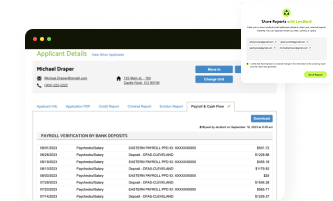
The fix is narrow and cheap. Keep the signed authorization, order only from an FCRA-compliant provider, and never reuse an old report for a new application. LeaseRunner captures authorization inside the application. The applicant enters their own data, so the landlord never touches a Social Security number.
Adverse action notice checklist
An adverse action notice is required whenever report information contributes to a denial. It also applies to a higher deposit, a co-signer demand, or any other less favorable term. A self-managing owner with one duplex owes the same notice as a national operator.
A compliant notice generally includes:
- The name, address, and toll-free number of the consumer reporting agency that supplied the report. Add a line noting that the agency did not make the decision.
- The right to a free copy of the report within sixty days. Note the right to dispute wrong or incomplete data with the agency.
- The credit score used, the score range, and the main factors that lowered it, whenever a score shaped the outcome.
- The date, the property, and the decision were kept on file as proof that the notice went out.
Some states add their own layer. A few require the landlord to state the real reason instead of pointing at the report. A template solves this permanently, and LeaseRunner's guide to what to include in an adverse action letter walks through the wording line by line. Sending the notice within a few days, every time, closes the most common gap in tenant screening laws compliance.
Fair Housing Act & Criminal History
The Fair Housing Act (FHA) protects seven federal classes. They are race, color, religion, sex, national origin, familial status, and disability. Fair housing act tenant screening rules reach open bias and neutral policies alike. A neutral rule still fails if it creates a disparate impact on a protected class. Criminal history is the classic example, since conviction data does not fall evenly across the population.
Then the ground shifted. On November 25, 2025, HUD Secretary Scott Turner rescinded three criminal screening guidance documents. The agency formalized those withdrawals in Federal Register notices published April 6 and July 17, 2026. The list includes the 2016 guidance that had discouraged blanket bans. HUD has also proposed scrapping its disparate impact rule, though that rulemaking was still pending in July 2026.
Withdrawn guidance is not a repealed statute. The Fair Housing Act still bars unjustified discriminatory effects, and courts still hear disparate impact claims after Inclusive Communities. Applicants also have two years to sue in federal or state court. A blanket criminal ban is the most exposed position a landlord can take.
LeaseRunner's breakdown of HUD criminal background check requirements shows what a defensible policy looks like instead. Protected classes' tenant screening risk now gets decided in courtrooms rather than agency memos, which makes documentation worth more, not less.
5 Common Categories of State/Local Tenant Screening Laws

Tenant screening laws by state look chaotic from a distance. Nearly every rule falls into one of five buckets, and checking those five covers most of what tenant screening laws add at the local level.
Source-of-Income Protections
Roughly half the country treats rental assistance as income. The federal posture on this shifted in 2025.
About 24 states and the District of Columbia bar source-of-income discrimination. PRRAC's March 2026 tracker estimates that most voucher households now live in a covered jurisdiction. Under those laws, "no Section 8" advertising is unlawful. So is the three-times-rent rule applied to the full rent rather than the tenant's portion? HUD withdrew its own November 2024 source-of-income guidance in July 2026. That shifts the federal reading, yet every state and city statute stands. Landlords should confirm the rule with the state or local housing authority before setting an income multiple.
Criminal History & "Fair Chance" Screening Rules
A fair chance housing law does not ban criminal checks. It controls when the check happens and how the result gets used. New York City's Local Law 24 took effect on January 1, 2025, and sets the strictest model. A covered provider finishes credit, income, and reference screening first, then issues a conditional offer.
Next comes the Fair Chance Housing Notice, and only then a look at a narrow band of reviewable convictions. Pulling the offer requires written reasons tied to a legitimate business interest. Seattle goes further and bars most conviction-based denials outright. Landlords asking whether it is illegal to deny housing to a felon should start with the city ordinance. The local rule is usually tighter than the state statute.
Eviction Record Restrictions
An eviction filing is an allegation, not a verdict. A growing group of states now treats it that way. Massachusetts began letting tenants seal old eviction records in May 2025 under its Affordable Homes Act. California, Nevada, Colorado, Minnesota, Illinois, Oregon, and New York offer some form of sealing or use limit.
Once a record is sealed, it must come off screening reports, and the FCRA's seven-year rule already bars most stale adverse entries. Denying an applicant over a dismissed 2019 filing invites a discrimination claim in the wrong city and an FCRA dispute anywhere.
Portable Tenant Screening Reports (PTSR)
Under HB23-1099 and HB25-1236, effective January 1, 2026, a Colorado landlord must accept a compliant applicant-supplied report. The landlord cannot charge an application or access fee alongside it, and can no longer dictate how the report arrives. Violations carry $2,500 in damages plus costs and fees, with a $50 cure if fixed within seven days. Applicants using a housing subsidy no longer need to include credit history.
New York waives the fee entirely when an applicant supplies checks completed in the prior thirty days. Maryland and Washington tie acceptance to a disclosure duty, while California keeps the practice voluntary. LeaseRunner issues state-specific portable reports for Colorado, California, Illinois, Washington, and Maryland for exactly this reason.
Application Fee Caps
Fee rules are the easiest category to follow. They are also the easiest to break at scale.
California's ceiling rose to $65.86 for 2026 and adjusts with inflation each December. Virginia caps the nonrefundable fee at $50, and New Jersey added its own $50 cap effective May 1, 2026.
New York limits the charge to $20 or actual cost, while Massachusetts and Vermont effectively ban screening fees. Several states also require an itemized receipt and a refund of the unused portion. Charging a flat $75 across a multi-state portfolio is a quiet, repeatable violation, and plaintiffs' lawyers find it easily.
The Newest Compliance Risk: AI and Algorithmic Screening Tools

The Fair Housing Act applies to an algorithm just as it applies to a leasing agent. Tenant screening laws follow the decision, not the decision-maker, so a landlord cannot hand liability to a vendor.
HUD said so in its April 2024 screening guidance. The Justice Department said so in court. In a 2024 fair housing class action in Massachusetts, the court held that a screening company is subject to the Fair Housing Act.
The vendor settled that November for $2.275 million. It also agreed to stop issuing approve or decline recommendations for voucher applicants unless the model is validated for fairness. The core allegation was simple. The score leaned on credit data and ignored the rent paid directly by a state or local housing authority.
The federal guidance layer has thinned since. HUD's companion digital advertising guidance was withdrawn on April 6, 2026, and the screening guidance now sits in HUD's archive. State law moved the same way. Colorado repealed its AI Act before it took effect, and the replacement, SB 26-189, starts January 1, 2027. It centers on notice, an explanation of adverse automated decisions, and human review.
None of that removes the exposure, because private suits do not need agency guidance. Landlords using a scored product should audit the vendor now:
- Ask which inputs feed the score. Watch for proxies that track a protected class indirectly, such as ZIP code, arrest data, or medical debt.
- Ask whether the model was validated for fairness, and by whom.
- Ask whether the vendor returns raw records or a recommendation, then keep the final call with a human who documents it.
A score is evidence, not a verdict. Landlords who record why they accepted or rejected that score turn an opaque number into a defensible file.
Why Automated Screening Reduces Legal Risk?
Compliance failures under tenant screening laws rarely come from missing one rule. They come from tracking six rules at once by hand.
One applicant can trigger five duties in a single afternoon. FCRA authorization and notice, fair chance sequencing, a source-of-income calculation, a portable report obligation, and a fee cap all apply at once. Those duties stack rather than queue, so missing one is enough. Manual work makes the miss likely, because the landlord has to recall every rule at the moment of decision.
Integrated screening moves those steps into the workflow. Authorization is captured before the report is ordered, and criminal results sit behind a conditional offer where a city requires that order. An applicant-supplied report is accepted where state law demands it, and the adverse action notice fires from the same record that produced the denial. That structure cuts both legal exposure and the hours spent re-reading statutes for every vacancy.
Consistency is the second gain. The same criteria apply to every applicant in the portfolio, so the landlord can show a written standard instead of relying on memory. That is the exact evidence that defeats a discrimination claim.
LeaseRunner's RS³ (Rental Screening Science Score) holds one scoring standard across a portfolio, so criteria stay consistent and auditable for an operator working in several states at once. Landlords still need to know the valid reasons to deny a rental application where the property sits, since a platform enforces process, not judgment.
Common Tenant Screening Compliance Mistakes to Avoid
Most claims under tenant screening laws trace back to a handful of habits. Treat what follows as a short tenant screening compliance checklist to run before the next vacancy.
Inconsistent Criteria Application
Waiving a credit minimum for one applicant and enforcing it on the next is the fastest route to a discrimination claim. Write the criteria down, publish them with the listing, and apply them in the order applications arrive. Documented consistency beats any single screening report in court.
Blunt Criminal Background Bans
A flat "no records" rule fails an individualized assessment test in every fair-chance city. It stays exposed under the Fair Housing Act everywhere else. Weigh the offense, its age, and evidence of rehabilitation, then record what the landlord actually considered.
Selective Income Verification Levels
Asking some applicants for pay stubs and taking a verbal figure from others is a textbook case of what landlords cannot do when screening tenants. Set one income standard. Apply it to the tenant's share of rent where source-of-income rules apply, and verify everyone the same way.
Skipping written applicant consent
No signature means no permissible purpose and no defense under the Fair Credit Reporting Act. Verbal permission does not meet the statute, and a scanned form buried in an email thread rarely survives an audit. Consent belongs in the application record with a timestamp.
Mishandling Adverse Action Letters
Landlords lose winnable cases by denying lawfully and then skipping the notice. Send it for every adverse decision, name the consumer reporting agency, and keep proof of delivery. A late notice and a missing notice carry the same penalty.
Failing to check the comprehensive history data
Screening based on credit score alone misses eviction filings, income fluctuations, and identity fraud. That pushes the landlord toward gut calls, which is what fair housing law punishes. Pull credit, criminal, eviction, and income data through one FCRA-compliant tenant screening platform. The record stays complete, and the criteria stay uniform for every applicant.
Conclusion
Tenant screening laws are a layered system, and the layers move at different speeds. Federal rules set the floor and never go away. States and cities keep adding height in five predictable places: source of income, fair chance, eviction records, portable reports and fees, and now algorithmic oversight.
The real risk is not any single rule. It is managing all of them at once, in real time, for every applicant. Tenants gain from the same discipline because a documented process is easier to question and pass. So confirm current state tenant screening regulations with counsel or the state or local housing authority first. Then let an integrated platform such as LeaseRunner carry the repeatable parts: consent, reports, sequencing, and notices.
FAQs
1. Do tenant screening laws vary by state?
Yes, substantially. Federal tenant screening laws set a nationwide floor. States and cities then add rules on source of income, criminal history, eviction records, portable reports, and application fees. A policy that is lawful in Texas can be a violation in Colorado or New York City, so criteria should be set on a jurisdiction-by-jurisdiction basis.
2. What is the most important federal tenant screening law?
Two share the title. The Fair Credit Reporting Act governs how a landlord obtains and acts on a screening report, including consent and adverse action notices. The Fair Housing Act governs the decision itself. It bars discrimination against protected classes, including neutral policies with unjustified discriminatory effects.
3. Can landlords deny an applicant for a criminal record?
Often yes, but rarely automatically. HUD withdrew its criminal screening guidance in 2025 and 2026, yet the statute and court precedent still apply to policies with a discriminatory effect. Fair-chance cities such as New York and Seattle also limit when the check may run and require written, individualized reasons for a denial.
4. What is a portable tenant screening report?
It is a screening report that an applicant buys once and reuses across applications, valid for a set window. Colorado requires landlords to accept a compliant report and waive the fee. New York waives the fee for applicant-supplied checks under thirty days old, and Maryland and Washington require landlords to disclose their policy.
5. Are AI-based tenant screening tools regulated?
Indirectly, the direction is shifting. Federal guidance on algorithmic screening has been withdrawn, but the Fair Housing Act still applies to automated decisions. A $2.275 million settlement by an algorithmic screening vendor in 2024 showed that clearly. Colorado's SB 26-189 adds notice and human-review requirements for automated decisions, effective January 1, 2027.
Disclaimer: The information provided in this post is intended for general informational and educational purposes only. It should not be construed as legal, accounting, or tax advice. For guidance specific to your situation, we recommend consulting with a qualified professional in the relevant field before taking any action based on the content provided.