
Landlord inspection laws in Washington State give a landlord the right to inspect a rental, but only under strict rules on written notice and timing. These rules come from RCW 59.18.150 of the Washington Residential Landlord-Tenant Act.
This article covers inspections that occur during a lease, along with related inspections a tenant may encounter, such as a check by a city code inspector.
Quick Summary: Washington State Landlord Inspection Laws
For a tenant with only a minute to spare, these five rules from the statute answer most inspection questions in Washington.
- A tenant can’t unreasonably refuse an inspection.
- Notice must be written and given at least two days in advance.
- The notice lists the date and time (or a time window) and a phone number for rescheduling.
- Entry happens at reasonable times, and access can’t be used to harass.
- Repeat violations after one written warning can cost up to $100 apiece.
The two-day rule has two exceptions: an emergency, or a situation where giving notice is impracticable.
A notice without a phone number, for example, gives the tenant grounds to write back and ask for a corrected one.
Can Washington Landlords Inspect Without Tenant Consent?
No, a Washington landlord needs the tenant’s consent for a routine inspection, but the tenant can’t refuse that consent without a good reason.
That two-way rule is the core of tenant consent for inspections in Washington. Under landlord inspection laws in Washington State, a tenant shouldn’t unreasonably say no when the landlord wants to inspect or make repairs. Apart from emergencies and abandoned units, a landlord who wants in without consent needs a court order or an arbitrator’s ruling. Source: Washington State Legislature.
The statute leaves “unreasonable” undefined, so the answer turns on the facts. A night-shift worker who gets a notice for 10 a.m. on a Tuesday can ask to move the visit to 3 p.m. and still be on solid ground. Ignoring three valid notices in a row is a different story. Walk-ins with no valid notice, along with the narrow emergency exception, fall under landlord entry without permission in Washington, which is a separate topic from a noticed inspection.
| Type of entry | Notice the landlord must give | Can the tenant say no? |
| Routine inspection or repair | At least 2 days, in writing | Only with a good reason |
| Showing to buyers or new renters | At least 1 day | Only with a good reason |
| Emergency or abandonment | None required | No |
| Code enforcement inspection (complaint-based) | Consent, or a court warrant with written notice of the hearing | Yes, though the inspector may then ask a judge for a warrant |
That last row is easy to miss. If a tenant calls the city about mold and lets the inspector in, the statute bars the landlord from retaliating over that consent. Some Washington cities also run routine rental inspection programs, and state law lets a city require one no more than once every three years for each property. Source: Washington State Legislature.
What Must a Washington Inspection Notice Include?
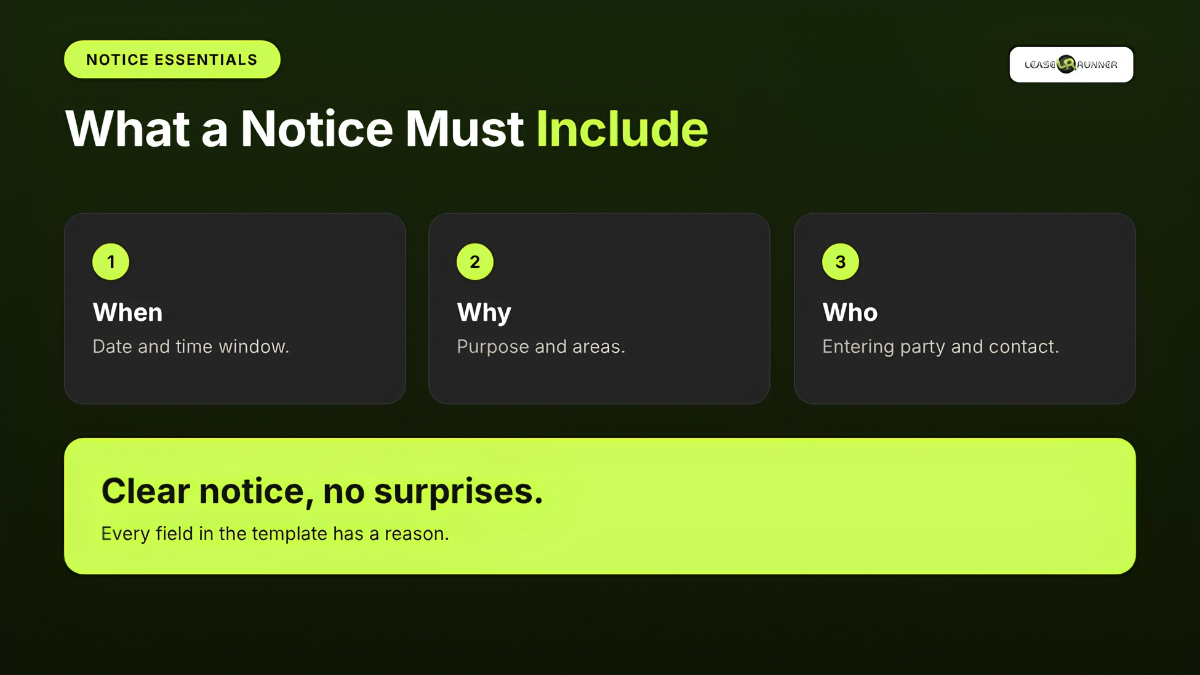
Four things, according to the statute. If one is missing, the tenant can reply to request a corrected notice before opening the door.
Start with timing. A two-day written inspection notice is the floor, and it has to be in writing (a phone call or a quick mention in the hallway won’t do). The other three pieces are:
- The exact date and time, or a window showing the earliest and latest possible arrival
- A phone number the tenant can call to object or reschedule
- An entry time at a reasonable hour
Specific inspection dates and time windows are what make a notice useful. “Sometime next week” fails the rule, but “Thursday the 12th, between 10 a.m. and 1 p.m.” works fine. The statute does not define a reasonable hour, so a weekday daytime slot is the safest bet.
The phone number for rescheduling gives the tenant a real person to call when the window clashes with work. LeaseRunner goes deeper on delivery in its guide to an inspection notice to tenants. One check worth doing: if the notice went up Thursday evening for a Friday morning visit, that’s well under two days, and the tenant can ask for a new date.
Washington Limits on Inspection Frequency and Scope

No number in Washington law says how many inspections a year is too many. A landlord can still break landlord inspection laws in Washington State by showing up too often or poking around too much once inside.
Limits on Frequency
RCW 59.18.150 sets no limit on the number of visits. The closest limits are its ban on abusing access or using it to harass, and on excessively exhibiting the unit. Before objecting to another visit, a tenant should also pull out the lease, since some leases specify how often inspections occur. Source: Washington State Legislature.
A landlord who sends three notices in two weeks for a “routine walkthrough,” with no repair behind any of them, may be crossing that line. A tenant who gets notices like these should keep each one and write down the date it arrived. Those dates help if the tenant later files a harassment claim.
Limits on Scope
RCW 59.18.150 allows a landlord to enter the premises to inspect or make repairs, so the landlord is there to look at the unit itself. If the landlord starts flipping through the tenant’s mail or snapping photos of personal paperwork, the visit is no longer an inspection, and the tenant could treat it as harassment.
Nothing in the act says the tenant must be home, but asking to be there is allowed and often heads off trouble. LeaseRunner explains where a fair check ends in its guide on what a landlord can look at during an inspection.
How to Handle Rescheduling and Access Violations

Most scheduling conflicts get fixed with one phone call. For those that don’t, Washington provides tenants with a written process and a small monetary penalty.
Requesting a New Inspection Time
A tenant who can’t make the window should call the number listed, then put the request in writing. Offering two concrete times helps a lot. If the notice says Wednesday from 9 to 11 a.m., the tenant might reply with Thursday after 4 p.m. or Friday morning.
One delay is fine. Pushing the date back by weeks can backfire, though, because the landlord can apply the same $100 penalty to a tenant who repeatedly blocks lawful entry.
Sending a Written Violation Notice
Say the landlord lets himself in on a Saturday with no notice at all. The tenant’s next move is a written notice of access-rights violations, meaning one letter, written in good faith, that lists the date and time of each violation. A useful letter usually covers:
- Each date and time the landlord came in improperly or sent a bad notice
- What went wrong, for example, no written notice, or arrival two hours after the window closed
- A request to follow RCW 59.18.150 from now on
Certified mail with a return receipt is the easiest way to prove delivery. Keep a copy too.
Recovering Damages After Notice
Once the landlord has that letter, every new violation can cost up to $100. Whoever wins in court or arbitration can also recover costs and reasonable attorney fees. Source: Washington State Legislature.
A quick example: the letter arrives March 1, and the landlord still comes in without proper notice on March 10, 18, and 25. That adds up to $300, plus costs if the tenant wins. Anything before March 1 doesn’t count toward the penalty, so mailing the letter right after the first bad entry matters.
Landlord inspection laws in Washington State fit in one section of the statute, yet that short section gives a tenant real leverage. A tenant who saves each notice and answers in writing when the timing doesn’t work is already in good shape.
If a landlord keeps ignoring the rules, one letter starts the $100 clock. LeaseRunner suggests keeping that paper trail until the lease ends.
Disclaimer: The information provided in this post is intended for general informational and educational purposes only. It should not be construed as legal, accounting, or tax advice. For guidance specific to your situation, we recommend consulting with a qualified professional in the relevant field before taking any action based on the content provided.