An inspection notice to tenants that skips the entry date or gives too little time can turn a routine visit into an unlawful entry. An inspection notice is a written message telling tenants when, why, and by whom their rental will be entered. This guide from LeaseRunner covers a free fill-in template, the fields every notice needs, notice periods in ten states, and the records that prove delivery.
Free Inspection Notice Template You Can Copy
A landlord inspection notice works best when it lists every entry detail in one place, and a fill-in form makes that easy. Use our free Notice of Intent to Enter Premises template (PDF) to document required entry fields across your rental properties.
| NOTICE OF INTENT TO ENTER PREMISES Notice Date: [MM/DD/YYYY] Tenant Name(s): [Full Name of All Adult Tenants] Property Address: [Street Address, Unit #, City, State, ZIP] Entry Date: [MM/DD/YYYY] Time Window: [Start Time, e.g., 9:00 AM] to [End Time, e.g., 12:00 PM] Purpose & Areas: [e.g., Routine mid-lease condition check, smoke detector inspection] Entering Party: [Landlord / Property Manager / Maintenance Contractor Name] Tenant Presence: [ ] Tenant presence required | [ ] Tenant presence optional (Entry via master key if absent) Notice Period Given: [__] hours/days under [State Law / Statute] Reschedule Contact: Phone: [Phone Number] | Email: [Email Address] Delivery Method: [Hand Delivered / Posted on Door / Email / Certified Mail] Landlord/Manager Signature: ____________________________ Date Signed: [MM/DD/YYYY] |
Pro Tip: Always follow whichever rule is stricter between your lease agreement terms and statutory state law. If state law permits 24 hours of advance notice but your lease promises 48 hours, you must honor the 48-hour requirement.
What to Include in an Inspection Notice
A complete inspection notice covers the details that state landlord-tenant laws commonly require or expect. Missing details may leave the notice open to challenge.
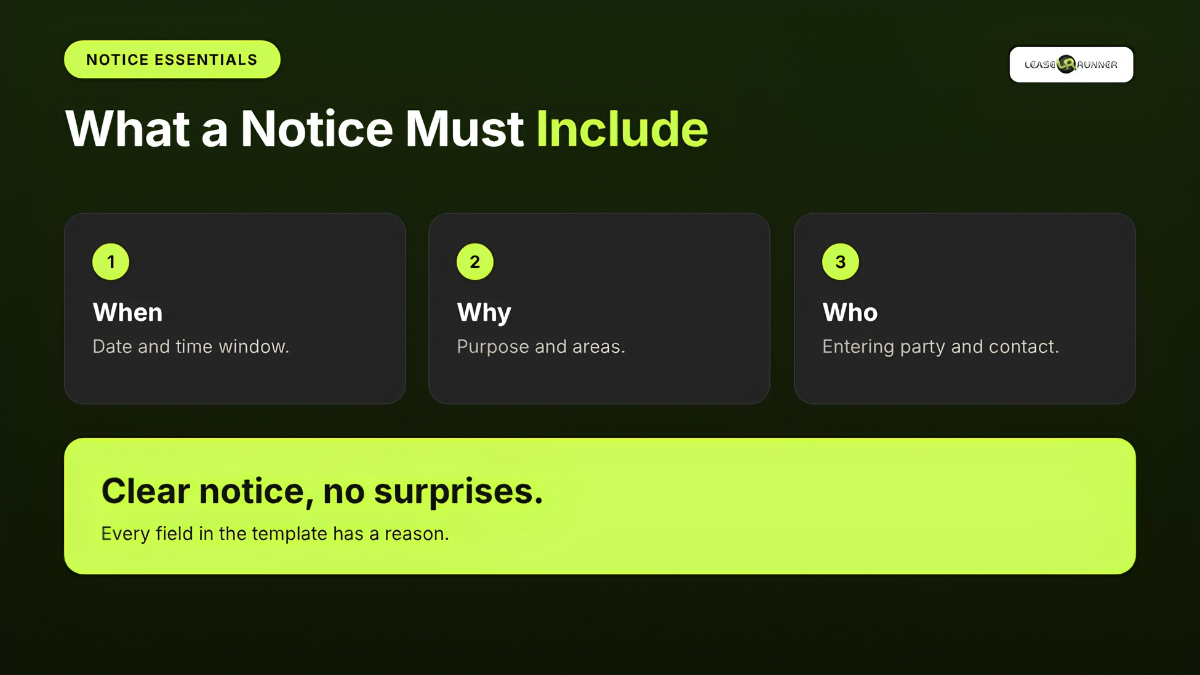
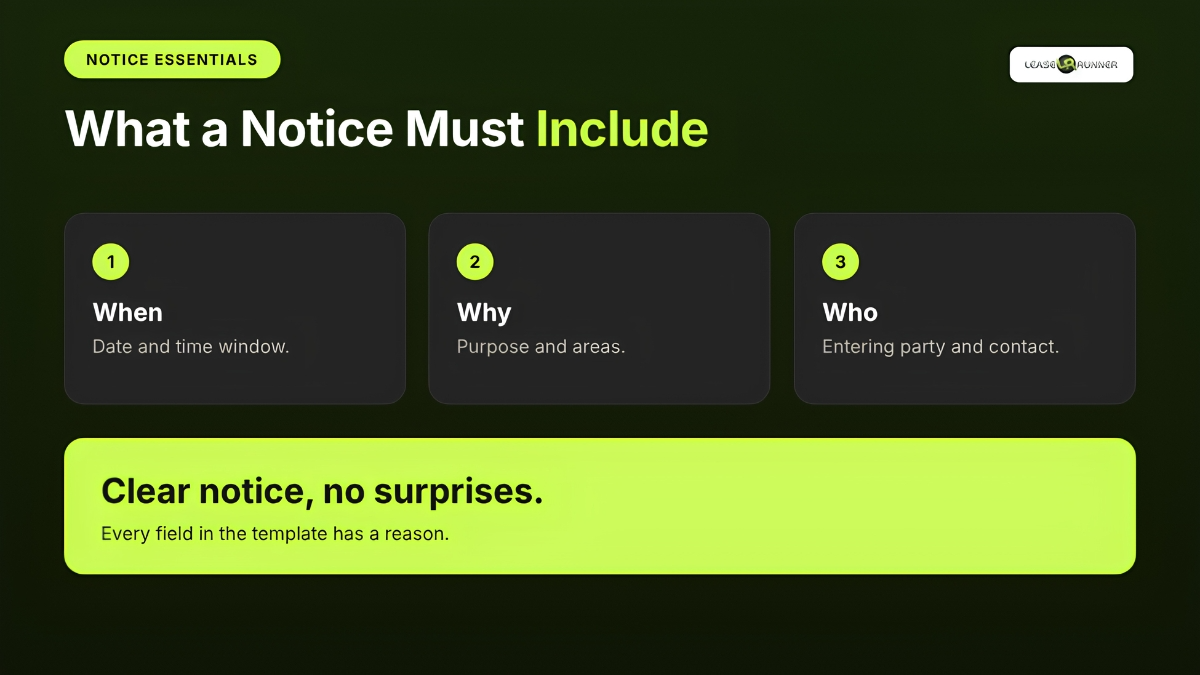
Include the following essential details in every written notice of landlord inspection:
- Notice date: The date you issue the notice. Also record the date the tenant received it, to show the full notice period passed.
- Tenant names, address, and unit. List every tenant on the lease so the notice traces to the right household.
- Entry date and time window. A start and end time lets tenants plan and avoids vague “sometime this week” notices.
- Purpose and scope. State the reason, such as a routine mid-lease condition check or smoke detector test. Our guide on what can a landlord look at during an inspection explains the limits.
- Entering party. Name the landlord, property manager, or contractor who will enter.
- Tenant presence and access. Say whether the tenant must be home and how the landlord enters if no one is.
- Reschedule contact. Give a phone number and email so tenants can request a new time.
Washington shows how the law can require these fields. RCW 59.18.150(6) requires the notice to state the exact date and time, or a window with the earliest and latest entry times, plus a phone number for objections or rescheduling. Source: Washington State Legislature, RCW 59.18.150.
How Much Notice Must Landlords Give Tenants?
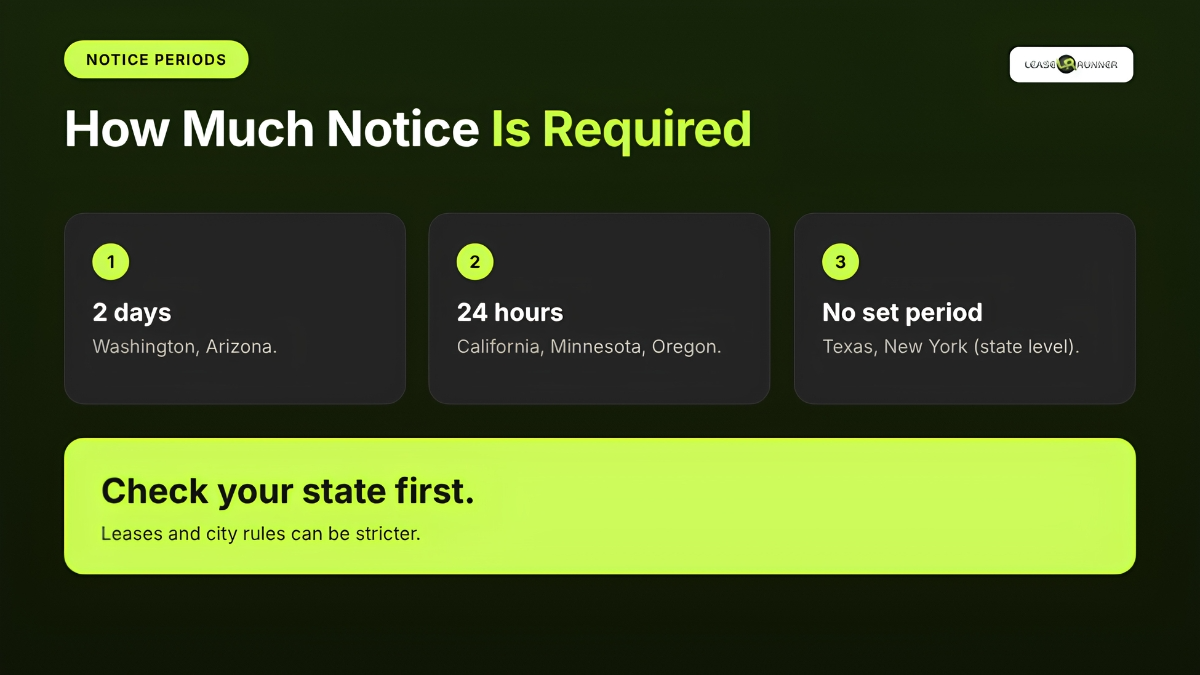
The answer depends on state law: Washington and Arizona require two days, California, Minnesota, and Oregon use a 24-hour baseline, and Texas and New York set no statewide period.
Notice Periods by State
State law sets the minimum notice for a non-emergency inspection, and some states do not require it in writing:
| State | Notice rule | Statute |
| California | Written notice; 24 hours presumed reasonable; mailing at least 6 days before entry presumed reasonable | Civ. Code § 1954 |
| Washington | At least 2 days’ written notice; 1 day to show the unit to buyers or tenants | RCW 59.18.150(6) |
| Arizona | At least 2 days’ notice, at reasonable times | A.R.S. § 33-1343(D) |
| Minnesota | Good-faith effort at reasonable notice of at least 24 hours | Minn. Stat. § 504B.211 |
| Oregon | At least 24 hours’ actual notice | ORS 90.322(1)(f) |
| Ohio | Reasonable notice; 24 hours presumed reasonable | ORC § 5321.04(A)(8) |
| Florida | Reasonable notice; for repairs, at least 24 hours | Fla. Stat. § 83.53(2) |
| Virginia | Notice of intent at reasonable times; 72 hours for routine maintenance the tenant did not request | Va. Code § 55.1-1229 |
| Texas | No statewide notice statute; the lease controls | Tex. Prop. Code ch. 92 |
| New York | No statewide notice period; reasonable notice under the lease and local rules | N.Y. Real Property Law art. 7 |
Source: California Legislative Information, Civil Code § 1954; Washington State Legislature, RCW 59.18.150; Arizona Legislature, A.R.S. § 33-1343; Minnesota Revisor of Statutes, § 504B.211; Oregon Legislature, ORS chapter 90; Ohio Laws, ORC § 5321.04; Florida Legislature, Fla. Stat. § 83.53; Virginia Law, Va. Code § 55.1-1229; Texas Statutes, Property Code ch. 92; New York State Senate, Real Property Law art. 7.
Statutes change, and leases or city ordinances can be stricter. Landlords should confirm the current rule before sending a notice.
When You Can Skip Advance Notice
Landlords can skip advance notice in a real emergency, and some states also excuse it when the tenant consents at entry, requests repairs, or has abandoned the unit.
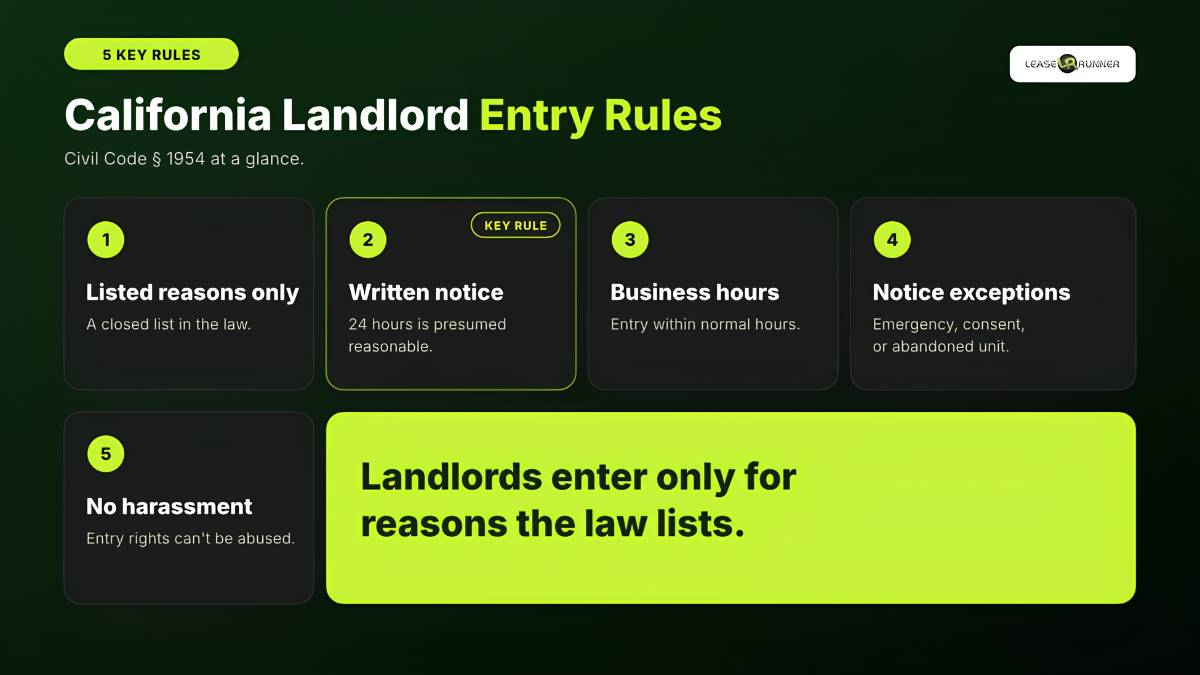
- Emergency. California, Washington, Arizona, and Oregon allow emergency entry without notice. Minnesota allows it when the landlord reasonably suspects immediate entry is needed to prevent injury to persons or property.
- Consent at entry. California excuses notice if the tenant is present and agrees to the entry at that moment.
- Repair requests. Arizona treats a tenant’s maintenance request as permission to enter for that work. Oregon allows entry without further notice for up to seven days after a written repair request.
- Abandonment. California, Washington, and Oregon allow entry without notice once the tenant has abandoned or surrendered the unit.
A routine inspection does not qualify as an emergency. Some states also require a record afterward: Oregon landlords must give actual notice within 24 hours of an emergency entry made in the tenant’s absence, and Minnesota landlords must leave a written disclosure of an entry made without notice while the tenant was away.
Source: California Legislative Information, Civil Code § 1954; Washington State Legislature, RCW 59.18.150; Arizona Legislature, A.R.S. § 33-1343; Oregon Legislature, ORS 90.322; Minnesota Revisor of Statutes, § 504B.211.
Timing Rules to Write Into the Notice
Write a specific entry date and a time window inside the hours state law allows, and allow the full notice period before entry. Oregon requires 24 hours of actual notice, so a mailed notice needs extra lead time to arrive.
- Permitted hours. California limits entry to normal business hours. Minnesota allows 8 a.m. to 8 p.m. unless landlord and tenant agree otherwise, and Florida sets 7:30 a.m. to 8 p.m. for repair entries. Washington, Arizona, Oregon, Ohio, and Virginia require “reasonable times” without fixing clock hours.
- Time window. Minnesota requires a time or anticipated window. Washington requires an exact time or a window with earliest and latest times. California requires an approximate time.
- Mailed notices. California presumes a mailed notice reasonable only if it is mailed at least six days before entry, so mail needs a longer lead time than hand delivery.
Source: California Legislative Information, Civil Code § 1954; Minnesota Revisor of Statutes, § 504B.211; Florida Legislature, Fla. Stat. § 83.53; Washington State Legislature, RCW 59.18.150.
How to Deliver the Notice and Prove It
Deliver the notice by hand, door posting, email or portal, or mail, and keep proof that matches the method.
- Hand delivery: record the date, time, and recipient’s name.
- Posted on the door: take a timestamped photo.
- Email or tenant portal: save a timestamped copy, if the lease allows electronic notices.
- Mail: use certified mail for a signed receipt, and in California mail at least six days before entry.
Posting is expressly allowed in California, which accepts a notice left on, near, or under the usual entry door where a reasonable person would find it. Other states and leases may differ. Source: California Legislative Information, Civil Code § 1954.
Keep a notice log for every entry: a copy of the notice, the delivery method, the date sent, and the person who delivered it. A text reminder can follow, but it never replaces the written notice. Once the notice is delivered, the visit follows the apartment inspection process. With our online rental contract tool, we keep lease-related files in one organized place, so each notice copy can sit beside its lease.
Disclaimer: The information provided in this post is intended for general informational and educational purposes only. It should not be construed as legal, accounting, or tax advice. For guidance specific to your situation, we recommend consulting with a qualified professional in the relevant field before taking any action based on the content provided.