California has no single law called an “inspection law.” Rental property inspection laws California come down to Civil Code § 1954, which controls when a landlord may enter a tenant’s home during a tenancy. This guide covers those mid-lease visits. Move-out inspections are a separate process under Civil Code § 1950.5. At LeaseRunner, we keep the two apart so tenants know which rules apply to which visit.
California Rental Property Inspection Laws: The Key Rules
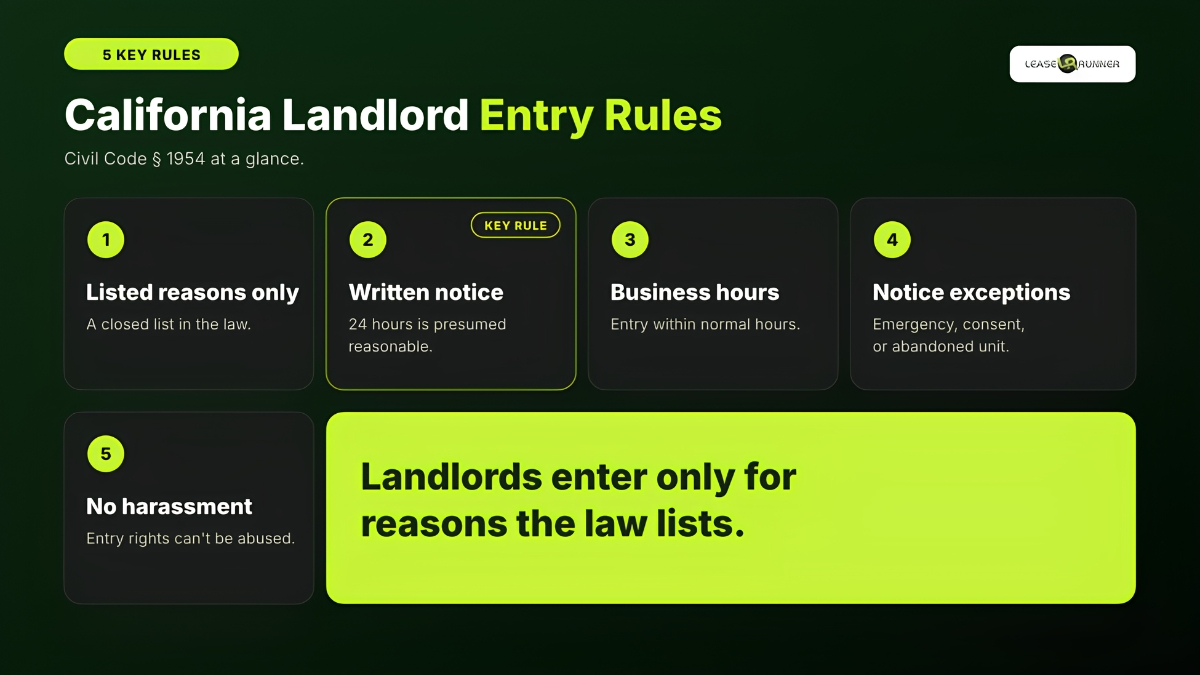
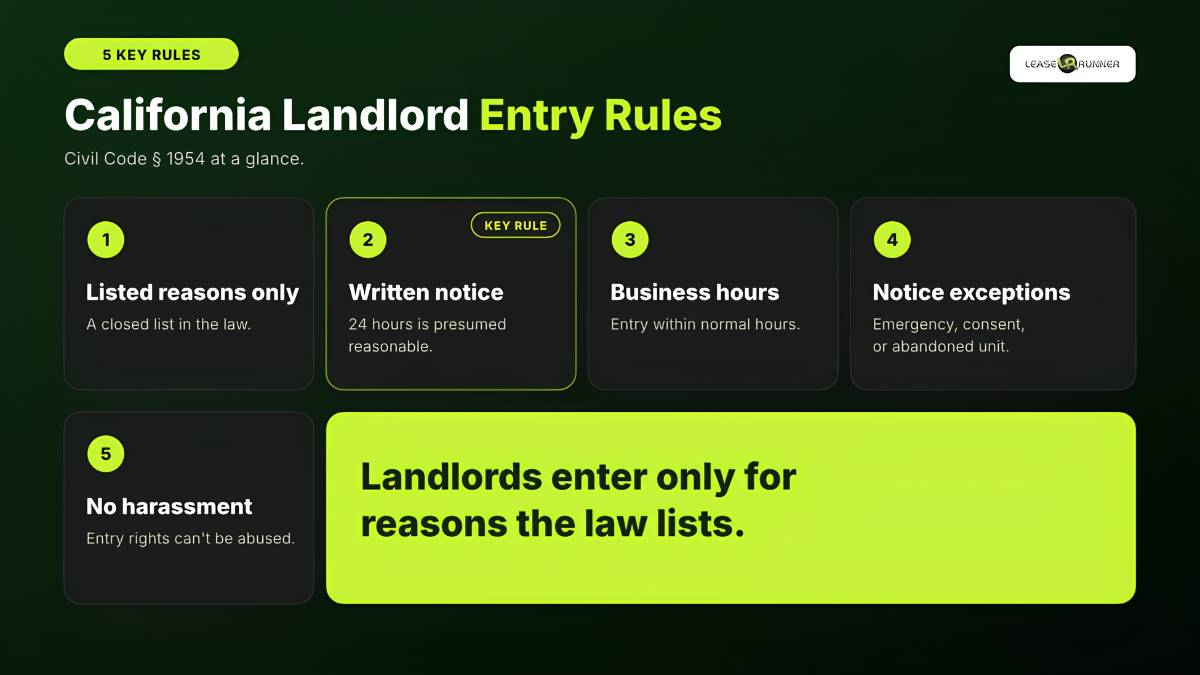
A California landlord can enter a rental only for a reason Civil Code § 1954 lists, and written notice is usually required first. These are the core rules under the California landlord inspection law:
- Entry is allowed only for the purposes the statute names.
- Written notice is required, 24 hours is presumed reasonable, and it must give the date, an approximate time, and the purpose.
- Visits must fall within normal business hours.
- Notice is not needed in an emergency, when the tenant is home and agrees at the moment of entry, or after the tenant has abandoned or surrendered the unit.
- A landlord cannot abuse the right of entry or use it to harass a tenant.
Source: California Legislative Information, Civil Code § 1954.
When Can a California Landlord Enter a Rental?
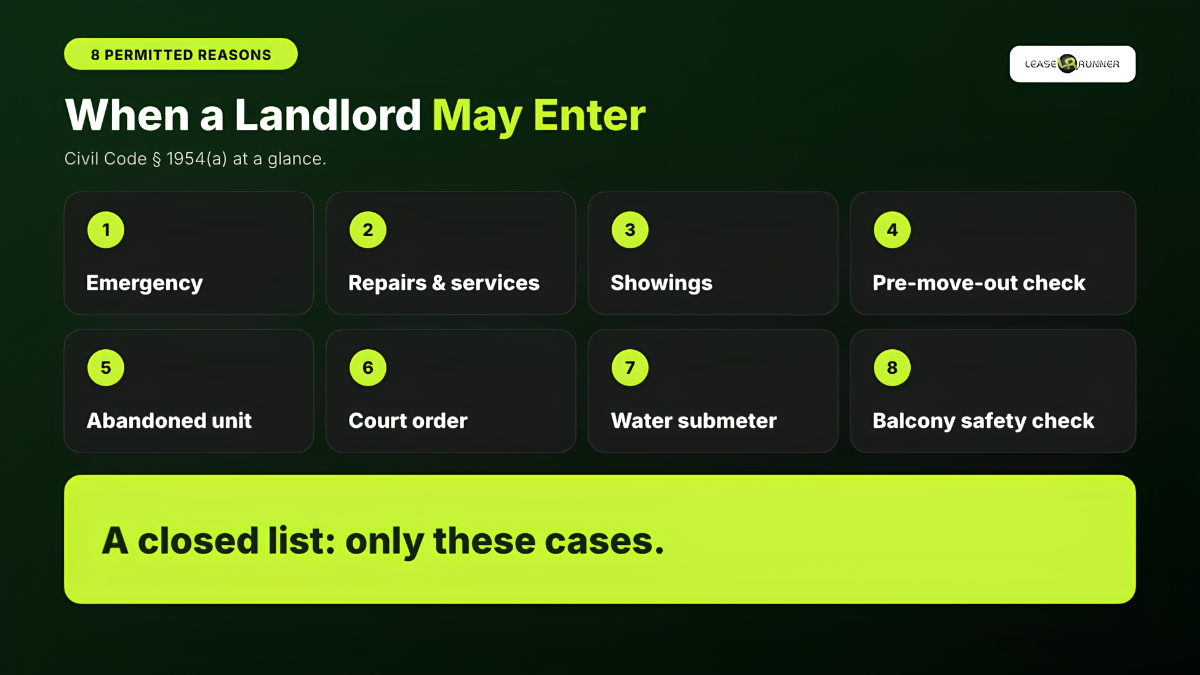
A California landlord may enter a rental only in the cases listed in Civil Code § 1954(a). In plain terms, those cases are:
- An emergency.
- Necessary or agreed repairs, decorating, remodeling, or improvements, or providing necessary or agreed services.
- Showing the unit to buyers, lenders, new tenants, workers, or contractors.
- An initial (pre-move-out) inspection under § 1950.5(f).
- The tenant has abandoned the unit (left with no plan to return) or surrendered it (formally given it back).
- A court order.
- Water submeters work under § 1954.201 and the sections that follow.
- Required inspections of balconies and other elevated exterior structures under Health and Safety Code § 17973 (SB 721).
This is a closed list. The statute opens with the words “only in the following cases,” so a reason outside the list does not qualify. Source: California Legislative Information, Civil Code § 1954; California Legislative Information, Health and Safety Code § 17973.
Safety-device laws also send landlords through the § 1954 process. A landlord may enter to install, repair, or test carbon monoxide devices under Health and Safety Code § 17926.1. A landlord may also enter to install, repair, or test smoke alarms under Health and Safety Code § 13113.7, but only with written notice during normal business hours. Source: California Legislative Information, Health and Safety Code § 17926.1; California Legislative Information, Health and Safety Code § 13113.7.
Are Routine Inspections Legal in California?
Section 1954 does not name routine inspections as a stand-alone reason to enter. That leaves a gap. A landlord needs one of the listed purposes, and a visit labeled “inspection” does not create one by itself.
In practice, landlords often tie a visit to a listed purpose, such as necessary repairs or services. Whether a particular visit fits depends on the facts, and a court may have to decide. A lease clause cannot waive a tenant’s rights under these sections. Source: California Legislative Information, Civil Code § 1953.
Even a lawful entry has limits once the landlord is inside. Our guide on what can a landlord look at during an inspection explains the scope of a visit and the tenant’s privacy.
Mid-lease entry and move-out inspections are also different things. A move-out inspection is tied to the security deposit and follows § 1950.5. Our California move-out inspection guide walks through that process. Source: California Legislative Information, Civil Code § 1950.5.
Notice Rules Under California Civil Code 1954
Under California Civil Code 1954, a landlord must give reasonable written notice before entering, and 24 hours is presumed reasonable. A presumption is not a fixed rule. Other facts can show that a different amount of notice was reasonable or not.
What Must the Written Notice Say?
The written notice must state the date, the approximate time, and the purpose of entry. The visit must also fall within normal business hours. The statute does not define that phrase, so the notice and the actual time of entry become the evidence in a dispute.
Entry outside normal business hours is allowed in only three situations: an emergency, an abandoned or surrendered unit, or a tenant who consents at the time of entry.
How Can a Landlord Deliver the Notice?
A landlord may hand the notice to the tenant, give it to a person of suitable age and discretion at the unit, or leave it on, near, or under the usual entrance where a reasonable person would find it. Mail also works, and notice mailed at least six days before entry is presumed reasonable. The statute does not list email as a delivery method. For showings to buyers, notice can be oral if the landlord gave written notice of the sale within the past 120 days; the landlord must then leave written evidence of the entry inside the unit.
When Does a Landlord Not Need to Give Notice?
A landlord does not need notice in an emergency, when the tenant has abandoned or surrendered the unit, or when the tenant is present and consents at the time of entry. There is one more route. A tenant and landlord may agree orally to an entry for agreed repairs or services. That agreement must set the date and approximate time, and the entry must fall within one week of the agreement. Source: California Legislative Information, Civil Code § 1954.
What if a Landlord Abuses the Right of Entry?
A tenant facing abuse of entry can object in writing and keep records, because § 1954 bars landlords from abusing access or using it to harass. Notices, dates of visits, and messages with the landlord all help. If a landlord significantly and intentionally violates § 1954 to pressure a tenant to move out, the tenant may recover a civil penalty of up to $2,000 per violation under Civil Code § 1940.2. Legal aid offices and local tenant organizations can advise on next steps.
Source: California Legislative Information, Civil Code § 1954; California Legislative Information, Civil Code § 1940.2.
This guide covers California only. Other states set their own entry rules, so tenants elsewhere should check their state’s law.
A California landlord can enter a rental during the tenancy only for a reason listed in Civil Code § 1954, and usually only after written notice during normal business hours. Routine visits have no stand-alone entry right, so each one needs a listed purpose. Tenants who keep their notices and visit dates are better prepared if a dispute comes up. At LeaseRunner, we publish plain-language guides on renting, tenant rights, and screening so renters can check the rules that apply to their state.
Disclaimer: The information provided in this post is intended for general informational and educational purposes only. It should not be construed as legal, accounting, or tax advice. For guidance specific to your situation, we recommend consulting with a qualified professional in the relevant field before taking any action based on the content provided.