A rental background check shows a tenant's credit history, eviction records, criminal history where permitted by law, and proof of income and identity. It does not show everything a landlord might assume. Sealed records, arrests without a conviction, and details tied to race, religion, or disability never appear on a lawful report.
Screening today touches every part of the application process, from a first credit pull to the final adverse action notice. This guide walks through exactly what a rental background check shows, what must be kept off it by law, and how landlords should weigh each result.
Key Takeaway
All screening must follow the Fair Credit Reporting Act and the Fair Housing Act. Landlords judge each report as a whole. They use consistent rules, not one data point.
What Is a Rental Background Check?
A rental background check is a structured screening process. Some people call it a rental check. Others call it an apartment rental background check. Either way, it checks whether an applicant meets set rental criteria.
From a legal standpoint, rental background checks fall under the Fair Credit Reporting Act (FCRA). That means landlords need written authorization from the applicant, the information reported must be accurate and verifiable, and any adverse decision has to follow a formal notice process.
Landlords often ask whether they're even allowed to run background checks. They are, as long as the screening standards apply equally to every applicant, avoid discrimination, and are directly connected to tenancy risk.
A complete background check typically answers:
- Can the applicant pay rent on time?
- Has the applicant complied with prior leases?
- Is there a documented eviction risk?
- Is the applicant's identity verifiable?
- Does income support the rent amount?
What Shows Up on a Rental Background Check?
The contents of rental background checks vary by provider, state law, and landlord preference. However, most comprehensive reports include the categories below.
1. Criminal Background Information

Criminal history is one of the most regulated parts of tenant screening. Many landlords ask if apartments really run these checks. Some also wonder if no-criminal-background-check apartments exist. The answer depends on where the property sits. Some cities delay the check itself. Others just cap how far back a landlord can look.
- New Jersey's Fair Chance in Housing Act prohibits any questions or checks about criminal history until after a conditional offer. Once that offer goes out, landlords can only weigh convictions from the past 1 to 6 years, depending on the severity of the offense.
- Cook County, Illinois, runs a similar process under its Just Housing Amendment. A landlord must first qualify the applicant on income, credit, and rental history. Only then can the landlord run a criminal check, and it may include only convictions from the last three years.
- Washington State takes a lighter approach. Landlords must put their screening criteria in writing and judge each applicant's criminal record on its own merits, not by blanket denial.
- Seattle pushed further with its own Fair Chance Housing Ordinance, though a 2023 federal appeals court ruling struck down the piece that barred landlords from even asking about criminal history. Seattle landlords can now ask, but denying someone based on the answer is still off limits, except in cases tied to the sex offender registry.
- Detroit's Fair Chance Ordinance covers landlords with five or more rental units. It delays the criminal check until the applicant has cleared all other screening steps.
Two mechanisms explain most of these rules. A delayed review pushes the criminal check later in the process, after income and rental history clear. A look-back window limits the number of years of criminal history a landlord may consider when making the decision.
When permitted, a criminal check can show felony and misdemeanor convictions, the types of crimes, and the dates. It can show pending charges, too, depending on state law. Most reports also check sex offender registries like the NSOPW.
A few limits apply everywhere, though. An arrest without a conviction should never count against someone. A blanket ban on anyone with a criminal record can violate fair housing rules. Most places require a case-by-case look instead.
2. Eviction History

Eviction history is one of the strongest predictors of future rental risk, and court-filed evictions do show up on a background check. The eviction report pulls data from court records nationwide, detailing any formal legal process a previous landlord started to remove the tenant.
- Formal Filings: The report will show the dates and outcomes of any Unlawful Detainer or Forcible Entry and Detainer actions filed against the applicant.
- Judgments: It is vital to see if the court ruled in favor of the landlord (a judgment). A simple filing that was later dismissed is less concerning than a final judgment.
- Collection Accounts: Often, an eviction results in a judgment for unpaid rent, which can be turned into a collection account.
Important distinctions:
- A filing alone may appear, even without a judgment.
- Under the FCRA, eviction records — which are civil suits — generally cannot be reported after seven years. Some states go further.
- Certain jurisdictions restrict the use of dismissed cases.
Applicants may challenge incorrect records through formal disputes. LeaseRunner guides how to dispute an eviction on a tenant screening report.
3. Credit Report
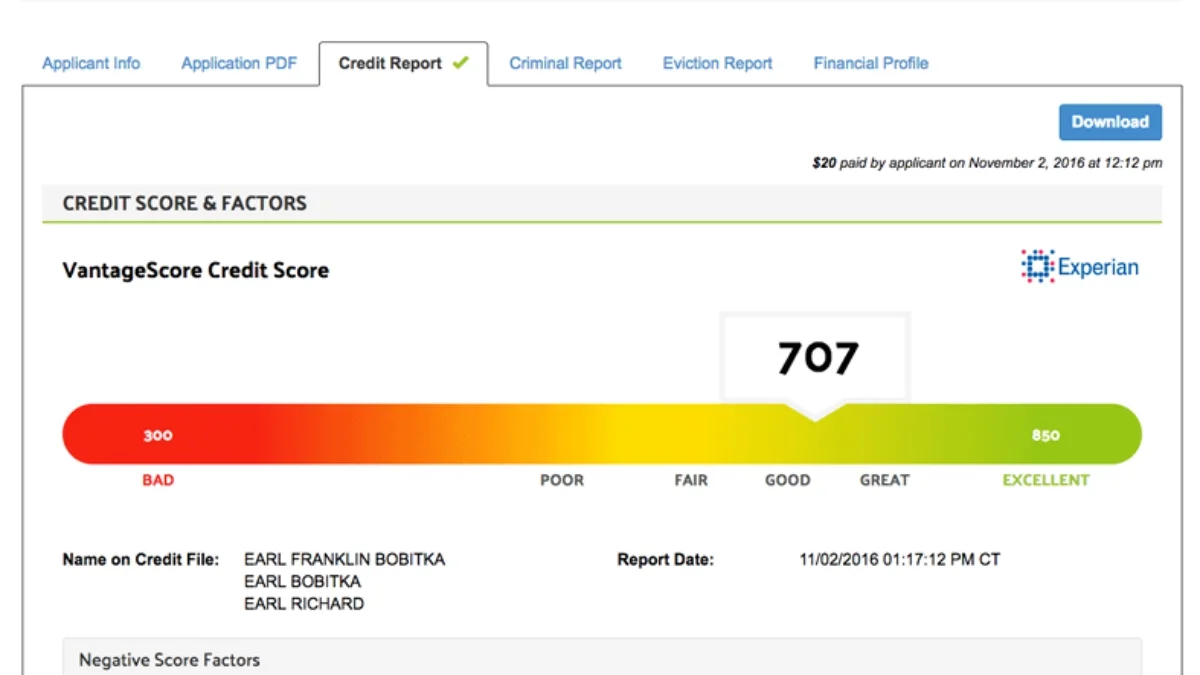
A credit check is a fundamental part of the process, often referred to as a credit background check for landlords. It helps assess financial responsibility and the ability to meet lease obligations.
- Credit Score: The score (e.g., FICO or VantageScore) provides a snapshot of credit risk. Landlords often set a minimum acceptable score (e.g., 620-650).
- Payment History: This details the applicant's record of paying various debts (mortgages, credit cards, loans) on time.
- Debt Load: The report shows the current debt amount, which is crucial for assessing the applicant's debt-to-income ratio.
- Public Records: Bankruptcy is the only public record still on a credit report today. Under CFPB-reported changes, the three major credit bureaus removed all civil judgments and about half of tax liens in July 2017, then cleared the remaining tax liens by April 2018. Landlords who expect to see a tax lien on a credit report will not find one there.
- Collections: Collection accounts for past due debts do show up on a background check. This covers accounts from utility companies, medical bills, or previous landlords, and it signals a pattern of falling behind on financial commitments.
Landlords should look not only at the score but also at the reasons for any negative marks. For example, a high debt load from student loans may be viewed differently from multiple recent credit card defaults.
Not every negative mark carries equal weight, and medical debt in particular follows its own set of rules on a credit report today. A federal court struck down a CFPB rule that would have banned all medical debt from credit reports nationwide, so no federal ban exists as of 2026. Even so, Equifax, Experian, and TransUnion made voluntary changes years earlier that still stand.
Since 2022, they have removed medical debt once it's paid in full. Since 2023, they have stopped collecting on any medical debt under $500. Unpaid medical debt over $500 also gets a full year before it can appear, up from six months.
Landlords may still see larger unpaid medical debt that is past the one-year mark, though newer scoring models like VantageScore 4.0 exclude medical debt from the score entirely, while FICO gives it less weight than other debts.
Paid collections follow a similar pattern. They can still show up on a report, but they carry far less weight than an open, unpaid balance, since newer scoring models treat a paid collection as a much smaller risk factor than one still owed. Landlords should check whether a collection account is marked paid or still open before treating it as a red flag.
4. Rental History Verification
While credit and eviction records provide objective data, direct verification of past tenancy provides crucial context and subjective feedback on behavior. The screening process facilitates contacting previous landlords to verify:
- Lease Terms: Confirmation of the dates the applicant rented the property.
- Timeliness of Payments: Verification of whether rent was consistently paid on or before the due date.
- Property Condition: Feedback on how well the tenant maintained the unit and whether the security deposit was returned.
- Notices and Violations: Information on any lease violations, noise complaints, or notices to pay or quit.
Common documents include:
- Landlord referral letter: A written statement from a previous landlord confirming lease dates, rent payment behavior, and overall tenancy conduct.
- Proof of rent payment letter: A formal letter or record showing consistent rent payments, often supported by bank statements or receipts.
- Proof of residency letter: A document verifying prior residential address and length of occupancy. It supports address history accuracy when public records are incomplete or delayed.
5. Identity Verification
Identity verification protects landlords from fraud and identity misuse.
Verification typically checks:
- Name and Address History: Verifies the applicant’s current legal name and provides a list of previous residences, which can be cross-referenced with rental history.
- Social Security Number (SSN) or Individual Taxpayer Identification Number (ITIN) Verification: Confirms the validity of the number provided and its connection to the applicant's name.
For applicants without SSNs, alternative processes exist. LeaseRunner explains these in what is called identity proofing and a background check without a Social Security number.
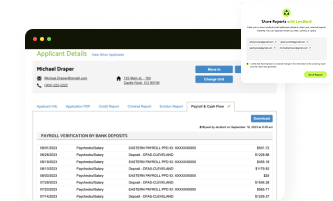
6. Employment & Income Verification

A potential tenant’s ability to pay rent is directly tied to their employment and income stability. While not part of the standard apartment rental background check run through credit bureaus, it is a mandatory step for responsible landlords.
- Employment Status: Verification of current employer, job title, and duration of employment. Landlords often check for a stable work history. Verification usually means contacting the employer's HR department or reviewing recent pay stubs
- Income Documentation: Confirmation that the applicant meets the landlord’s income requirement, usually 2.5 to 3 times the monthly rent. Documents like pay stubs, W-2s, tax returns, or bank statements are used. Applicants should have proof of income ready before applying.
Stable income often offsets weaker credit profiles.
What Does Not Show Up in a Rental Background Check?
While a rental background check is exhaustive, it is equally important for landlords to understand what information is legally restricted from being reported or considered.
Protected Characteristics
The Fair Housing Act (FHA) prohibits discrimination based on protected classes. As a result, certain personal details about the applicant are never included in a legal background check report:
- Race, color, national origin
- Religion
- Sex (including gender identity and sexual orientation in many jurisdictions)
- Familial status (presence of children under 18)
- Disability
Landlords must not base a decision on any of these characteristics.
Time-Barred Negative Information
The FCRA dictates how long negative information can remain on a consumer report. So, how far back does a rental background check go? For most negative marks, the answer is seven years, though a couple of categories work very differently.
Landlords who expect civil suits, judgments, or tax liens to age off after seven years are looking for something that isn't there at all, regardless of how old it is.
Non-Court Evictions
Only formal evictions filed in a court of law will appear on an eviction report. If a tenant simply broke their lease and moved out, or if the landlord used a “cash for keys" agreement, this private transaction will not surface in a public records search. This highlights the importance of the direct rental history verification step.
Sealed or Expunged Records
If a criminal record has been legally sealed, expunged, or otherwise set aside by the court, it will not appear on a compliant background check report. These legal actions treat the offense as if it never occurred.
Personal Lifestyle Information
Details that are purely personal and not directly related to financial or legal reliability are excluded from a lawful screening report. This includes:
- Political affiliations
- Religious memberships
- Information about friends or non-occupant family members
- Medical history or specific health conditions
Medical information is limited under FCRA §604(g), which restricts how a screening company can include medical details in a consumer report and how a landlord can use them once received.
On top of that, the Fair Housing Act and the Americans with Disabilities Act prohibit landlords from denying housing based on disability, so a medical condition should never factor into a rental decision.
Private Financial Details
Credit reports do not reveal:
- Bank balances
- Investment accounts
- Spending categories
Only summarized credit behavior appears.
How Landlords Use Background Check Results to Make Decisions

Understanding what landlords look for in background check reports is the key to effectively using the data. The goal is to move beyond mere information gathering to objective risk assessment.
Establish Clear Screening Criteria Before Running Checks
Sound screening begins before any rental background checks are ordered. Landlords should establish written criteria that define approval, conditional approval, and denial standards.
Clear criteria typically outline:
- Minimum income-to-rent ratios
- Acceptable credit risk thresholds
- Eviction history lookback periods
- Criminal history exclusions based on local law
Documented standards serve two critical purposes. First, they ensure consistent application across all applicants. Second, they provide compliance protection if a decision is challenged.
Without predefined criteria, background check data can be misused or applied unevenly, increasing the risk of fair housing violations.
Evaluate Risk Versus Mitigating Factors
A common mistake in tenant screening is treating every negative data point as an automatic disqualifier. A lawful apartment rental background check requires contextual evaluation instead.
Examples of mitigating factors include:
- High income with minor credit delinquencies
- Older evictions followed by a stable rental history
- Medical or temporary hardship-related collections
- Co-signers or guarantors, where legally permitted
A personal reference letter deserves this same careful weighing. It can add real context, especially when an applicant explains an old eviction or a rough financial stretch. But the applicant chose who wrote it, so it carries a built-in bias that hard data does not. Treat a reference letter as one input among several, never as a stand-in for the credit, eviction, or income figures already in the screening report.
Automatic denials based on a single factor also carry legal risk. Courts still apply the Fair Housing Act's disparate impact standard to blanket screening policies. A rule that rejects every applicant with, say, any eviction or any collection account can expose a landlord to a discrimination claim, even without any intent to discriminate. Risk should be assessed in totality, not in isolation.
Focus on the “Big Three”: Eviction, Credit, and Criminal History
Most screening decisions center on three core data categories:
- Eviction History: Prior evictions are often the strongest predictor of future rental risk. Court-filed cases typically carry more weight than dismissed filings. Recent patterns matter more than isolated, older incidents.
- Credit Report: A credit background check for landlords highlights payment behavior, not personal spending. Late payments, rental-related collections, and judgments are more relevant than overall debt levels.
- Criminal Background (When Permitted): Criminal records must be evaluated within legal limits. Convictions related to property damage or safety may be considered, while arrests without conviction should not influence decisions.
Apply Adverse Action Compliance Correctly
When a landlord denies an application or imposes conditions based on a third-party screening report, the Fair Credit Reporting Act (FCRA) requires that an Adverse Action Notice be provided.
An adverse action notice must include:
- The reason for denial or conditional approval
- The name and contact information of the screening provider
- A statement that the provider did not make the decision
- Instructions on how the applicant can request a copy of the report
- Information on how to dispute inaccuracies
Failure to provide proper notice may result in legal liability, even if the screening decision itself was justified.
How Tenants Can Prepare for a Rental Background Check
While this article is written for landlords, knowing what good tenants do to prepare can help them identify organized and serious applicants. A well-prepared applicant is often a better risk.
Landlords should encourage tenants to review their own history and be ready to address any issues:
- Order Their Own Reports: Applicants who check their credit and eviction history in advance can identify and correct errors or proactively explain any negative marks.
- Gather Necessary Documents: Having proof of income, a proof-of-residency letter, and contact information for prior landlords ready makes the verification process much faster.
- Understand the Process: Tenants need to know how to pass an apartment background check and be prepared to pay the application fee, which covers screening costs.
Landlords using a service like LeaseRunner can benefit from the speed and efficiency of the digital process, which helps answer the question, how long does tenant screening take.
Conclusion
So, what does a rental background check show? It shows a legally defined snapshot of credit history, eviction records, income, and criminal history, where permitted by law. It also leaves out protected traits, sealed records, and old public records bureaus that no longer report.
The goal is consistency, not certainty. Landlords who weigh every report equally stay compliant and make better decisions. Platforms like the LeaseRunner help deliver that full picture in one place.
FAQs
1. Do rental background checks show criminal history?
Usually, yes, where the law allows it. Some cities and states limit when it gets reviewed. A typical report covers felony and misdemeanor convictions, at the national, state, and county levels, and checks sex offender registries, too.
2. How long does a rental background check take, and who pays for it?
Most checks finish in minutes to a few days. Credit and eviction reports usually come back fast, often in minutes. Criminal checks can take 1 to 3 business days, since some records require manual review. The applicant almost always pays. Landlords typically fold that cost into the application fee.
3. Does a rental background check include a credit score?
Yes. A credit background check for landlords includes a full credit report and score. That covers payment history, debt load, bankruptcies, and collections.
4. Do background checks show my rental history?
Partially. Court records, such as eviction and judgment records, are pulled separately. Prior tenancy and payment behavior don't come the same way. A landlord has to check those by hand instead.
5. Can tenants see what’s on their rental background check?
Yes. Under the FCRA, applicants can request a copy of their report. They get it from the consumer reporting agency that the landlord used.
Disclaimer: The information provided in this post is intended for general informational and educational purposes only. It should not be construed as legal, accounting, or tax advice. For guidance specific to your situation, we recommend consulting with a qualified professional in the relevant field before taking any action based on the content provided.