Apartment income requirements are the minimum earnings a landlord or property manager typically expects before approving a lease application. In most parts of the U.S., apartment applicants need a gross monthly income equal to 2.5 to 3 times the monthly rent, although luxury buildings, competitive rental markets, and affordable housing programs may follow different standards.
For example, a prospective tenant applying for a $1,500 apartment may need to show between $3,750 and $4,500 in monthly gross income through recent pay stubs, bank statements, tax returns, or other proof of income documents. Still, income requirements for renting an apartment vary based on the landlord, property type, credit profile, and local market conditions.
This guide explains how apartment rental income requirements work, what counts as qualifying income, which documents landlords usually request, and what options may help a rental applicant qualify for an apartment with lower income or nontraditional earnings.
Do Landlords Use Gross or Net Income?
Most landlords use gross monthly income rather than net income to decide whether an apartment applicant meets the income requirement for lease approval. Gross income is total earnings before taxes, healthcare contributions, or retirement deductions, which is a consistent, easy-to-verify number that appears directly on pay stubs and W-2 forms. Net income (take-home pay) varies too much between individuals to serve as a standardized screening baseline.
Using gross income as the benchmark also works in the applicant’s favor: gross figures are higher than take-home pay, which makes the 2.5x–3x thresholds easier to meet.
How Much Income Do You Need to Rent an Apartment?

These are common screening benchmarks, not legal requirements for every rental. Most apartment income requirements fall between 2.5x and 3x the monthly rent, although requirements vary by city, property type, credit score, debt-to-income ratio, employment stability, and previous rental history.
The three multipliers you will see most often:
The 3x rent rule is by far the most common because many landlords consider that ratio financially sustainable for long-term rent payments — the linked guide walks through the full formula, lookup tables, and city-by-city standards. For how these multipliers connect to affordability percentages like the 30% rule, see the rent-to-income ratio guide.
Apartment Income Requirement Examples by Rent Price
Apartment applicants often ask: “How much income to rent an apartment?” The answer depends heavily on monthly rent and the landlord’s required ratio.
The numbers above represent common apartment qualification requirements, not legal mandates. Some landlords approve applicants below standard thresholds when additional financial strengths exist. These examples assume income is calculated before taxes. If a landlord uses net income, debt-to-income ratio, or stricter screening criteria, the required amount may differ.
What Documents Count as Proof of Income for an Apartment?
Proof of income documents help landlords verify financial stability and evaluate rental application requirements. Most rental applicants are asked to provide one or more documents, and additional verification may be required when income is variable or nontraditional.
Common proof of income documents include:
- Recent pay stubs
- W-2 forms
- 1099 forms
- Tax returns
- Bank statements
- Offer letters
- Social Security award letters
- Pension statements
- Investment income statements
1. W-2 Employees
W-2 employees have the most straightforward documentation path. Standard verification includes:
- Recent pay stubs covering the last 30–60 days
- A W-2 form as supplemental annual verification
- An employment verification or offer letter (ideal for new jobs without pay stubs yet)
- Two to three months of bank statements showing payroll deposits
For a complete walkthrough of documentation strategies, the how to show proof of income guide covers acceptable formats and presentation tips for rental applications.
2. Self-Employed Renters and Freelancers
Self-employed renters face stricter screening due to fluctuating earnings. Landlords evaluate income stability through:
- 1099 forms: Forms (like 1099-NEC or 1099-MISC) from multiple clients that establish a clear pattern of freelance or contractor income.
- Tax returns (Schedule C): The primary IRS document showing net profit from self-employment. Landlords typically request the two most recent years to identify long-term income trends.
- Profit-and-loss (P&L) statement: A current-year P&L prepared by an accountant to reflect recent earnings not yet captured in a tax return.
- Bank statements: Six months of statements showing regular, active business deposits.
Self-employment income, freelance income, and contractor income may still qualify for apartment approval when documentation shows stable earnings patterns.
3. Proof of Income for Students
Students with limited employment history can use financial aid and scholarship award letters, part-time pay stubs paired with savings, or a parental guarantor whose income and credit are evaluated instead. This guide on renting an apartment without a job covers alternative documentation strategies.
4. Alternative Income Sources
Landlords frequently accept nontraditional, verifiable revenue streams when backed by official records and several months of supporting bank statements:
- Government benefits: Social Security Award Letters confirming monthly SSDI or SSI benefit amounts.
- Retirement distributions: Pension or monthly brokerage account distribution statements.
- Court-ordered support: A divorce decree or court order documenting ongoing alimony or child support payments.
- Investments & Subsidies: Dividend statements (Schedule D) or official Section 8 or Housing Choice Voucher paperwork confirming subsidy amounts.
A rental applicant using alternative income sources should provide official statements and several months of supporting bank records whenever possible.
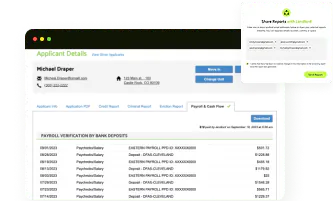
For a full breakdown of what landlords typically request across different income types, this documents needed for apartment rental guide serves as a useful checklist before submitting an application. On the landlord side, screening platforms like LeaseRunner’s income verification and cash flow report analyze bank deposit patterns to confirm the income shown on these documents.
What Counts as Income for Apartment Approval?
Apartment approval usually includes multiple income categories beyond standard payroll wages. Many prospective tenants qualify using combined household earnings, secondary income, or alternative financial sources.
1. Employment Income
For W-2 workers, gross income includes base salaries, hourly wages, reliable overtime pay, recurring sales commissions, and annual performance bonuses. Property managers evaluate these additions based on historical consistency. Contractual wages from a newly signed employment agreement or verified tips also count directly toward meeting the baseline income thresholds.
2. Self-Employment or 1099 Income
For freelancers and independent contractors, income is usually assessed using tax returns, reported earnings, and documented cash flow. Landlords may review net income after business expenses or analyze deposit patterns depending on their screening criteria.
3. Benefits, Support, and Other Income
Governmental aid programs, court-mandated domestic payments, official military allowances, and investment distributions count directly toward rental income requirements. Under statutory guidelines, property managers accept the Basic Allowance for Housing (BAH) managed by the U.S. Department of Defense as verifiable, tax-exempt income tied directly to military pay grades. Regular monthly distributions from trust funds, stock dividends, and real estate holdings also qualify, provided the underlying asset remains stable.
Additionally, individuals receiving monthly veteran benefits can track compensation metrics via the U.S. Department of Veterans Affairs to provide formal validation letters to landlords.
Rent an Apartment If Your Income Is Below 3x the Rent
An apartment applicant who does not meet the standard 3x income requirement can secure a lease by using a guarantor, adding a co-signer, applying with a roommate, or demonstrating substantial cash savings. Landlords are often willing to look past a lower baseline salary if the prospective tenant can mitigate financial risk through alternative structures.
Use a Guarantor
A guarantor (sometimes referred to as a lease guarantor) is an individual who agrees to take financial responsibility for rent payments if the primary tenant is unable to pay. Guarantors are not occupants of the rental unit and do not live in the property.
Unlike co-signers, who may share equal legal responsibility on the lease and sometimes be treated as co-applicants depending on the lease structure, guarantors primarily act as a financial backup and are only required to step in if the tenant defaults.
Guarantors usually need:
- Strong credit
- Stable income
- Higher income thresholds than tenants
- U.S.-based residency in many cases
In many rental markets, guarantor income expectations often range around 4x to 5x the monthly rent, although requirements can vary depending on property type, city, and landlord risk tolerance. Parents guaranteeing a lease for a college student is the most common scenario, but guarantors can be any financially stable adult willing to sign.
Add a Cosigner
Adding a co-signer is another highly effective strategy for qualifying for an apartment with lower individual earnings. Similar to a guarantor, a co-signer legally agrees to take responsibility for rent payments and any property damages if the primary tenant defaults on the contract.
The distinction lies in occupancy; a co-signer frequently retains the legal right to occupy the rental unit alongside the primary resident. Property managers review the co-signer’s credit report and annual gross income to offset the financial risk of the primary apartment applicant.
Before adding a co-signer, review the apartment rental cosigner guide to understand the legal implications and how to structure the arrangement clearly in the lease.
Combine Income With a Roommate or Partner
An apartment applicant can pool financial resources with a roommate or domestic partner to meet the rental application income requirements collectively. When multiple adults apply together as co-applicants, most property managers combine individual gross monthly incomes to determine if the household meets the 3x rent rule.
For example, if a rental unit costs $2,000 per month, two roommates each earning $3,000 per month can comfortably satisfy the $6,000 collective requirement.
Show Strong Savings
Savings can strengthen an application when recurring income falls below apartment qualification requirements. Landlords may view substantial reserves favorably when applicants provide:
- Bank statements
- Savings account balances
- Investment account records
- Emergency funds
Some landlords consider 6 to 12 months of rent in liquid savings a compensating financial factor.
Offer a Larger Deposit or Prepaid Rent Where Allowed
In some cases, offering additional upfront funds may help reduce a landlord’s perceived risk during the approval process. Some landlords may consider a higher security deposit or several months of prepaid rent from applicants who fall below standard apartment income requirements.
Security deposit limits, however, are regulated by state law in many areas. For example:
- California generally limits security deposits to one month’s rent for most residential landlords under Assembly Bill 12 (AB 12), which amended California Civil Code § 1950.5.
- New York caps security deposits at one month's rent under the Housing Stability and Tenant Protection Act of 2019.
Apartment applicants should always review local landlord-tenant laws before offering prepaid rent arrangements.
Apply With Private Landlords
Seeking out independent, private landlords instead of large corporate property management groups often yields more flexible income standards. Corporate leasing offices rely on rigid, automated screening software that automatically rejects a rental applicant who drops below the 3x ratio.
Individual property owners are more likely to review an application holistically, taking personal character, solid references, and a clean rental history into account.
Income Requirements vs. Income-Restricted Apartments: What’s the Difference?
Standard apartment income requirements set a minimum income - applicants must earn enough to afford the rent. Affordable housing income limits, by contrast, set a maximum income - applicants must earn below a certain threshold to qualify for subsidized housing.
For a traditional apartment, a landlord may require a prospective tenant to earn 2.5x to 3x the monthly rent. Income-restricted housing, however, uses maximum household income limits based on local Area Median Income (AMI) guidelines.
Most income-restricted apartments operate under federal or state-supported affordable housing programs, including:
- Low-Income Housing Tax Credit (LIHTC): A federal program that incentivizes developers to build affordable housing by offering tax credits. LIHTC properties typically require household income at or below 60% of AMI.
- Section 8 / Housing Choice Voucher Program: Administered by the U.S. Department of Housing and Urban Development (HUD), this program subsidizes rent for very low-income families, typically those earning 50% or less of AMI.
- Public Housing: Federally subsidized housing managed by local Public Housing Authorities (PHAs), with income limits varying by household size and local AMI.
Standard apartment income requirements and income-restricted housing follow very different qualification rules. The table below highlights the key differences.
Some rental applicants earn too little to meet standard apartment income requirements but too much to qualify for affordable housing programs. Housing advocates often describe this affordability gap as the “missing middle.”
A more detailed explanation of eligibility rules, AMI limits, and application requirements is available in this guide on income-restricted apartments.
Apartment Income Requirement Checklist Before You Apply
To avoid losing non-refundable application fees, a prospective tenant should review this comprehensive pre-application checklist to ensure all financial criteria match the target rental property requirements.
- Calculate Total Gross Monthly Income: Total all base wages, reliable bonuses, tips, and secondary income streams before any tax withholding.
- Determine Target Rent Threshold: Divide total household gross monthly income by three to find the maximum affordable market-rate monthly rent.
- Gather Two Months of Pay Stubs: Collect consecutive, recent pay stubs if employed as a traditional W-2 worker.
- Download Three Months of Bank Statements: Ensure PDFs show full account summaries, account holder names, and clear deposit histories.
- Retrieve the Most Recent Tax Returns: Have signed copies of Federal Form 1040 and accompanying 1099 records ready if self-employed.
- Organize proof of alternative income: Benefit letters, pension statements, child support documentation, or scholarship records may help support the application.
- Consider a guarantor or co-signer if needed: A guarantor may strengthen an application when income falls below standard apartment income requirements.
- Review credit reports before applying: Outstanding collections, eviction records, or major credit issues may affect apartment approval decisions.
Additional affordability guidance is available in this guide on debt-to-income ratio apartment calculations.
Conclusion
Apartment income requirements usually range from 2.5x to 3x monthly rent, but landlords also evaluate credit, savings, employment stability, and overall financial risk during tenant screening. Many apartment applicants still qualify through co-signers, roommates, guarantors, or alternative proof of income when earnings fall below standard thresholds.
Understanding apartment rental income requirements before applying can reduce denials, save application fees, and improve lease approval odds. LeaseRunner offers additional resources for renters and landlords navigating income verification, rental applications, and tenant screening requirements.
FAQs
1. Can Students Meet Apartment Income Requirements?
Yes. Students often qualify using part-time employment income, financial aid, scholarships, savings, or a guarantor. Many landlords accept co-signers for student apartment applicants with limited earnings history.
2. Is 3x rent the standard income requirement?
Often, but not always. While the 3x rent rule remains the most common industry benchmark for apartment qualification in the U.S., it is a market convention rather than a legal standard. Depending on the location and property type, some landlords accept a 2.5x income threshold to attract more applicants, while luxury buildings in competitive urban areas frequently apply stricter requirements, such as 4xtimes or higher.
3. Can savings replace income for apartment approval?
Sometimes, depending entirely on landlord and property policies. Substantial liquid savings can serve as an alternative qualification method, but only if the property owner explicitly permits asset-based screening.
Because there is no steady, recurring paycheck to rely on, landlords who accept this approach typically require a significant cash balance—often equal to the full rent for the entire lease term plus an additional financial cushion. This screening path is highly policy-dependent and is most commonly utilized by retirees, international students with institutional funding, or individuals in major career transitions.
4. Do student loans count as income for an apartment?
Student loans may count as income in some cases if the landlord accepts loan disbursements as a verifiable source of funds for living expenses. Acceptance depends on the property’s rental policies and screening criteria.
When considered, rental applicants may need to provide an official loan award or disbursement statement showing the approved amount and payment schedule. Landlords may review these documents to confirm that available funds can support both tuition and housing costs, although approval standards vary significantly by property.
5. How much rent can I afford if I make $5,000 a month?
Using the 3x rent rule, a renter earning $5,000 gross monthly income may qualify for apartments around $1,650 monthly rent. Under the 2.5x rule, affordability may increase to approximately $2,000 monthly rent, depending on debt obligations and credit profile.
Disclaimer: The information provided in this post is intended for general informational and educational purposes only. It should not be construed as legal, accounting, or tax advice. For guidance specific to your situation, we recommend consulting with a qualified professional in the relevant field before taking any action based on the content provided.