Most apartments use gross income when reviewing rental applications, but the exact income requirement depends on the property. Applicants who understand how landlords calculate income, verify earnings, and apply rent-to-income ratios can better prepare the right documents and avoid surprises during the approval process.
The Short Answer: Apartments Use Gross Income
Most apartments use gross income rather than net income when evaluating rental applications. Gross income is the amount earned before taxes and payroll deductions, making it the standard figure used for most apartment income requirements and rent-to-income calculations.
Many renters ask what income apartments look at or whether apartments go by gross or net income. In most cases, landlords rely on gross income because it provides a consistent financial benchmark during income screening.

Several common guidelines use pre-tax income to determine whether an applicant meets a property's minimum income requirement:
- 3x Rent Rule: Many landlords expect an applicant's gross monthly income to equal at least three times the monthly rent. For example, renting a $2,000 apartment generally requires about $6,000 in gross monthly income.
- 40x Rent Rule: Many landlords in New York City use the 40x rent rule, which compares annual gross income to monthly rent. A renter applying for a $3,000 apartment may need approximately $120,000 in annual gross income. The 40x rule is a common screening guideline rather than a legal requirement.
- HUD's 30% Affordability Guideline: The U.S. Department of Housing and Urban Development (HUD) commonly uses the 30% rule as an affordability benchmark. Households spending more than 30% of gross income on housing may be considered cost-burdened for housing policy purposes. However, the guideline is not a rental qualification requirement and is separate from the income standards individual landlords choose to apply.
Using gross income gives landlords a consistent benchmark for evaluating applications, while allowing applicants to understand the property's minimum income requirement before applying.
Gross Income vs. Net Income: What's the Difference?
Gross income is the total amount earned before taxes, while net income is the amount remaining after taxes and payroll deductions. Apartments almost always evaluate gross income rather than net income during income screening.
Understanding the difference helps answer another common question: is rent based on gross or net income? In nearly every case, landlords calculate affordability using pre-tax income, while renters should build a monthly budget using take-home pay.
Payroll deductions vary drastically between individuals based on personal retirement contributions, healthcare selections, childcare accounts, and local tax brackets. Two applicants with the exact same gross earnings can possess entirely different net pay envelopes due to independent benefit choices. Because net pay fluctuates based on discretionary allocations, housing providers default to gross income to analyze core earning power.
Why Do Landlords Use Gross Income Instead of Net?
Most landlords use gross income because it provides a consistent, verifiable, and objective way to evaluate whether an applicant can afford rent. Net income varies based on taxes and personal payroll deductions, making it less suitable as a standardized screening measure.
A More Consistent, Comparable Number
Gross income creates a consistent benchmark because every applicant is evaluated using earnings before taxes and payroll deductions. Individual choices regarding optional 401(k) contributions, health savings accounts (HSAs), or voluntary wage garnishments reduce net income but do not lessen an individual's fundamental capacity to earn. Property managers need an objective data point to run reliable rent-to-income ratios across hundreds of distinct applications.
For example:
Using a consistent benchmark also supports common income guidelines such as the 3x rent rule and the 40x rent rule.
Easier to Verify on Official Documents
Gross income is generally easier to verify because official employment and tax documents report earnings before deductions.
Documents such as pay stubs showing gross earnings per pay period and year-to-date (YTD) income, W-2 forms, offer letters, and IRS Form 1040 tax returns typically provide reliable proof of income. Many landlords also use income verification services to securely confirm payroll or financial information with an applicant's authorization.
Reviewing standardized financial documents helps simplify the application review process and reduces the need to estimate income from fluctuating take-home pay.

Safer for Fair Housing Compliance
Applying the same income standard to every applicant supports more consistent screening practices. The federal Fair Housing Act prohibits housing discrimination based on protected characteristics. Although the law does not require landlords to use gross income, many housing providers apply the same financial qualification standards to every applicant to promote consistency and reduce subjective decision-making.
Gross income is only one part of tenant screening. Credit history, rental history, employment, and other screening factors should also be evaluated using written criteria that comply with applicable federal, state, and local laws.
How Do Landlords Verify Your Gross Income?
Property managers confirm gross income by utilizing automated screening platforms alongside traditional financial documentation provided by the applicant. Landlords deploy rigorous verification procedures to confirm that the presented earnings are authentic, current, and legally verifiable. Falsifying document numbers constitutes application fraud and triggers an immediate denial.

Standard Verification Methods
Applicants with traditional W-2 employment usually verify gross income using standard employment and payroll documents.
- Pay Stubs: Landlords usually request the two or three most recent consecutive pay stubs. They review the gross pay for each pay period together with the year-to-date (YTD) earnings to confirm current, consistent income.
- W-2 Tax Forms: A W-2 summarizes annual wages reported by an employer for the previous tax year. During income verification, landlords commonly review W-2 Box 1 together with recent pay stubs or other proof of income to better understand an applicant's annual earnings. Because a W-2 reflects income from the prior tax year, many landlords also request recent payroll documents to verify current employment and income.
- Employment Offer Letters: For individuals starting a new position, an official corporate offer letter on company letterhead signed by human resources confirms future gross wages.
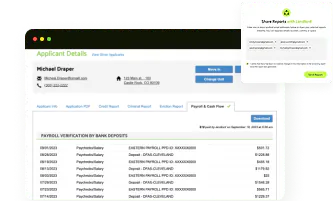
- Automated Income Verification: Advanced digital systems like the LeaseRunner Income Verification and Cash Flow Report securely pull real-time payroll and bank data directly from the financial institution, preventing document tampering.
Alternative Methods for Varied Income
Applicants with irregular, seasonal, or commission-based structures must provide alternative verification routes:
- Bank Statements: Providing 3 to 6 months of continuous bank statements verifies regular, predictable cash deposits.
- 1099 Forms: Independent contractors utilize Form 1099 to demonstrate the gross annual revenue collected from corporate clients.
- Tax Returns: Submitting an official IRS Form 1040 confirms historical earnings patterns over a multi-year period.
- Profit and Loss (P&L) Statement: A current P&L statement helps demonstrate recent business income and may be requested alongside tax returns for self-employed applicants.

Is There an Exception for Self-Employed or Gig Workers?
Yes. While standard employees are evaluated using gross income, landlords alter their calculation process for self-employed applicants by evaluating net business profit instead of gross business revenue. Property managers must distinguish between total business revenue and actual personal income, as business overhead expenses consume a large portion of business inflows.
To secure an apartment while self-employed, an applicant must understand how properties assess non-traditional financial profiles:
- Gross Revenue vs. Net Profit: A freelance graphic designer might generate $100,000 in gross revenue but incur $40,000 in business operational expenses. Landlords look at the remaining $60,000 of net business profit (found on IRS Schedule C, Line 31) as the realistic baseline for the rent-to-income ratio.
- Required Documentation: Independent contractors must present a finalized IRS Form 1040 along with a professional Profit and Loss (P&L) statement covering the current year to date.
- Demonstrating Consistency: Landlords look for continuous, predictable income over time. Self-employed applicants can consult guides on how to show proof of income to prepare complete and verifiable financial documentation.
Property managers need to ensure that the business earnings can withstand seasonal marketplace dips while meeting the income requirement consistently throughout the lease term.
What If Your Gross Income Doesn't Qualify?

If an applicant's gross income falls below the property's minimum income requirement, some landlords may accept alternative forms of financial support, depending on their screening policy. Landlords are often willing to offset lower gross earnings if the applicant can provide alternative safety nets that mitigate financial exposure.
If an individual's personal income screening falls short, several legal remedies remain available:
- Secure a Co-Signer or Guarantor: A co-signer or guarantor agrees to be financially responsible for the lease if the tenant defaults. The income requirement depends on the property's screening policy. Some New York City landlords use an 80x annual income guideline for guarantors, but this is not a nationwide standard.
- Utilize Institutional Guarantor Services: If a personal guarantor is unavailable, third-party companies can act as a corporate co-signer for a fee, usually ranging from 70% to 100% of one month's rent.
- Offer Additional Security Deposit Funds: Where permitted by state law, offering an advanced payment of rent or an elevated security deposit can persuade a property manager. Note: Some states, like California and New York, strictly limit security deposits to one month's rent, making this option legally unavailable in those areas.
- Strong Credit History: A strong credit history may help strengthen a rental application by showing a pattern of responsible credit management. Some landlords may consider strong credit alongside income, rental history, and other screening factors when reviewing an application. Learn more in LeaseRunner's guide to what credit score is needed to rent an apartment.
Conclusion
Gross income remains the standard most apartments use when calculating rent-to-income ratios, verifying proof of income, and determining whether an applicant meets the property's minimum income requirement. Although net income is important for personal budgeting, gross income provides landlords with a more consistent and verifiable screening benchmark. LeaseRunner's income verification and tenant screening tools help streamline the application process for both landlords and renters.
FAQs
1. Do landlords ever check net income at all?
Yes, some landlords review net income on bank statements to verify that an applicant possesses a realistic affordability buffer after automatic debt payments, child support, or tax levies are subtracted. While gross income determines initial qualification, a critically low net income could flag high default risks.
2. Does gross income include bonuses and overtime?
Yes, when the income is regular and documented. Landlords typically count consistent bonuses, commissions, and overtime pay as part of gross income, especially when a W-2 or several months of pay stubs show the pattern repeating.
3. What if my net income can't cover rent even though my gross qualifies?
If heavy pre-tax deductions or high personal debts leave your take-home pay insufficient to comfortably manage the rent, the applicant should look for a cheaper apartment. Even if a property approves an application based on gross income rules, the actual rent payment must align with real-world monthly cash flow.
4. Do landlords use gross or net income for the 3x rent rule specifically?
Landlords look at gross monthly income exclusively when applying the 3x rent rule. To determine qualification, multiply the monthly rent price by three; the applicant's total household monthly income before taxes must match or exceed that final target number.
Disclaimer: The information provided in this post is intended for general informational and educational purposes only. It should not be construed as legal, accounting, or tax advice. For guidance specific to your situation, we recommend consulting with a qualified professional in the relevant field before taking any action based on the content provided.