Can I refuse landlord inspection requests? Yes, but only when the request breaks the rules: no proper notice, an unreasonable time, or no lawful purpose. You generally cannot refuse a properly noticed inspection for a lawful reason, and no notice is needed in a real emergency. A refusal on weak grounds can turn a scheduling conflict into a lease problem, so most disputes end better with a new date. Below, we cover when you can object, when you must allow entry, and how to keep each step in writing.
Key takeaways
|
Can I Refuse a Landlord Inspection?

It depends on whether the landlord followed state notice, timing, and purpose rules. A tenant can turn away a visit without notice, but an unreasonable refusal of lawful access can breach the lease and state law.
Washington's RCW 59.18.150(1) says a tenant shall not unreasonably withhold consent to inspect, repair, or show the unit. Source: Washington State Legislature. Arizona's A.R.S. §33-1343(A) uses nearly the same words. Source: Arizona State Legislature. Both track the Uniform Residential Landlord and Tenant Act (URLTA), a model code adopted by many states. Where no general entry law exists, such as in Texas, the lease decides, so the state landlord-tenant laws page is the first stop.
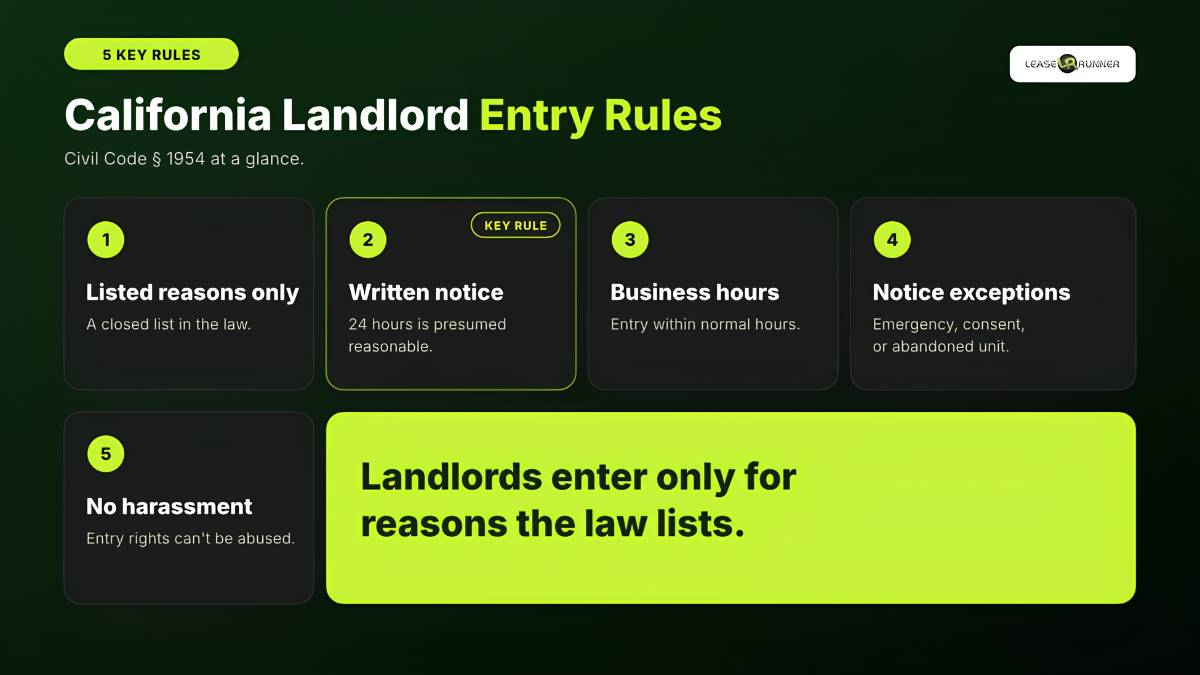
A lawful inspection is a landlord's entry into an occupied unit to check, repair, or show it, in accordance with state notice rules. It rests on advance notice, a reasonable time, and a real purpose. The details vary by state: Washington asks for two days' written notice, while California asks for 24 hours' written notice. Source: LA County DCBA.
A notice slipped under the door Monday at 9 a.m. for a Wednesday 10 a.m. smoke alarm check gives 49 hours, which meets Washington's two-day rule, while the same notice for Tuesday afternoon falls short. Whether you can object depends on which part of the notice failed.
| Situation | Can you refuse? | Why |
| Written notice on time, daytime routine check | Usually no | The law bars an unreasonable refusal of lawful access |
| No notice, or less than the state minimum | Usually yes | Inadequate notice fails the legal test |
| Visit set for 9 p.m. or early Sunday | Possibly | Laws require reasonable timing but rarely define it |
| Tenant asked for the repair (Arizona) | Usually no | The request counts as permission to enter |
| Weekly visits with no stated reason | Possibly | Entry laws ban using access to harass |
| Fire, gas leak, or burst pipe | No | Emergency access exceptions skip the notice step |
In every row, the tenant's leverage comes from a flaw in the notice, not a general right to say no.
Valid Grounds to Object to an Inspection
Most valid grounds to object to an inspection fall into two groups, and each one shapes how a tenant should word a reply.
Inadequate Notice and Unreasonable Timing

Inadequate notice and unreasonable timing give a tenant the strongest footing. Washington requires at least two days' written notice with an exact time or entry window, plus a phone number for objections. A note that says "sometime this week" fails that test. Washington does not define "reasonable times," so normal business hours are a fair benchmark. A 7 a.m. Sunday slot is a valid ground to object, but the reply should still offer a better hour.
No Lawful Purpose or Signs of Harassment
Washington and Arizona both bar landlords from using the right of access to harass a tenant. Warning signs include:
- Weekly "inspections" with no stated reason
- A sudden run of visits right after you complain to a housing agency
- A landlord who opens drawers or goes through personal belongings
You can check the scope against LeaseRunner's guide to what a landlord can inspect. Walls, plumbing, and smoke alarms are fair game, while personal belongings are not. A routine check every few months rarely constitutes harassment.
When Must a Tenant Allow Entry?
State law requires a tenant to allow entry in four situations, and a refusal in any of them leaves the tenant on weak legal ground:
- The landlord gives proper notice for a lawful purpose, such as a repair, a routine inspection, or a showing.
- The lease includes an inspection clause that complies with state law.
- A fire, gas leak, or burst pipe strikes. These emergency access exceptions allow entry without consent under RCW 59.18.150(5). Arizona's §33-1343(D) also drops notice when giving it is impracticable.
- A court orders access, or the unit appears abandoned.
Arizona adds a detail many renters miss: a tenant's maintenance request counts as permission to enter for that repair. Once the tenant asks for the fix, a refusal is hard to defend.
An unreasonable refusal of lawful access also costs money. In Washington, a landlord who sends one written notice of an improper refusal can recover up to $100 for each subsequent violation. So can you refuse landlord inspection visits that meet the rules? Not safely. When the notice is valid or there is an emergency, let the landlord in.
How to Request an Alternate Inspection Time

Requesting an alternate inspection time protects a busy schedule and keeps the tenant within the law. Four steps cover most cases:
- Reply in writing soon after the notice arrives, by email or the resident portal.
- Add a short reason if it helps, such as work, illness, or a family matter. Washington and Arizona law do not require a reason, so this note is a courtesy.
- Offer two or three specific dates and time windows.
- Ask the landlord to confirm the new time in writing.
A tenant may also ask to be present. Washington law does not guarantee that right, but nothing prevents a tenant from making the request. Washington notices must already include a phone number for rescheduling, so asking for a new time is a normal part of the process, not a conflict. Once you agree on a date, our guide on what to expect during an apartment inspection helps you plan for the visit.
How Should Inspection Disputes Be Handled in Writing?
Paper settles most inspection fights. Written objections and inspection records show who asked for what, and when.
For Tenants: Written Objections
A written objection names the notice date, states the problem in a line or two, and offers new times. Certified mail with a kept copy gives the best proof of sending, though email also stamps the date. Keep every notice, reply, and confirmation in one dated file. If the landlord has already entered without proper notice, see can a landlord inspect your apartment for the remedies in your state.
For Landlords: Responding to a Refusal

A landlord facing a tenant's refusal gets further with calm steps than with threats. LeaseRunner suggests this order:
- Ask why the tenant refused, since most refusals come down to timing or privacy.
- Offer new dates that still meet the notice rule.
- Point to the lease's inspection clause and the state entry law.
- Log every notice and reply in the inspection records.
- Call a local attorney if refusals continue without a valid reason.
A written objection deserves a written reply. Many disputes start with a vague lease, and a clear clause in a state-specific lease agreement template sets notice terms early.
Bottom Line
The fair answer to "Can I refuse landlord inspection?" is that a tenant can push back on a flawed notice, not a lawful one. Short notice, odd hours, and visits with no clear purpose give room to object. Proper notice for a repair, or an emergency access exception, usually leaves no room at all. In most cases, the best move is a quick written reply with two or three better times. That one message protects privacy and the tenancy at once. Landlords gain from the same habit, since a dated notice and a clean file settle most disputes before anyone mentions court. For any refused inspection, LeaseRunner's advice remains the same: put it in writing.
Disclaimer: The information provided in this post is intended for general informational and educational purposes only. It should not be construed as legal, accounting, or tax advice. For guidance specific to your situation, we recommend consulting with a qualified professional in the relevant field before taking any action based on the content provided.