Can you get an apartment with bad credit? Yes, and many renters in this situation secure leases every day by taking the right steps. A low credit score does not automatically disqualify you from renting, but it does change what landlords expect to see in the rest of your application.
For landlords reviewing these files, the real question is not whether to consider them at all. It is about evaluating them fairly, protecting yourself legally, and identifying those who will actually pay on time.
A credit check is the starting point of any rental application, but credit scores only capture part of the picture. A strong income, clean rental history, or a qualified cosigner can shift the outcome even when the number is low. This guide covers what the score actually tells you, what to require from these applicants, and how to make a confident decision without relying on a single number.

What Is Considered Bad Credit for Renting an Apartment?
Bad credit for renting generally means a FICO score below 620. That is the threshold most landlords and property managers treat as a baseline. In competitive urban markets, some corporate leasing offices filter out anything below 650 before a human reviews the file. In smaller markets or with individual landlords, 580 to 619 can still result in an approval with the right conditions attached.
The number is only part of what you are reading. Derogatory marks tell a separate story. A collection account from five years ago reads very differently from an eviction filed 18 months ago. A bankruptcy from a medical emergency reads differently from a pattern of missed payments across multiple accounts. Two applicants with the same score can carry completely different levels of actual risk.
Here is how score ranges typically translate into rental decisions:
Before you set your screening criteria, read through what landlords look for in a credit check so your process is thorough and consistent. Applying that standard evenly across all applicants also keeps you protected under the Fair Housing Act.
Takeaway: Set written credit criteria before screening season starts. Consistent standards protect you legally and enable you to make decisions faster when borderline applications come in.
Can You Rent an Apartment With Bad Credit?
Yes, you can rent an apartment with bad credit. Thousands of renters with scores below 620 sign leases every month by compensating with strong income, references, or upfront payments. The key is knowing what landlords evaluate and preparing your application accordingly.
From the landlord's side, you are not required to approve or deny anyone based solely on credit. What you are required to do is apply your criteria consistently to every applicant. If your rental application process relies entirely on a score cutoff, you are likely rejecting some reliable tenants and possibly missing red flags in applicants who just happen to clear the threshold.
If you do decline someone based on their credit report, the Fair Credit Reporting Act requires you to send them an adverse action notice. That notice must identify which credit bureau provided the report. Skipping this step creates legal exposure. Build it into your standard process so it happens automatically every time.
Knowing what credit score is needed to rent an apartment in your specific market also helps you calibrate your standards. A 620 minimum makes sense in many mid-sized cities. It may be too strict or too loose depending on your local vacancy rate and applicant pool.
Takeaway: A score below your threshold does not automatically mean no. It is a prompt to look more closely at the full application before making a decision.
How to Get Approved for an Apartment With Bad Credit?

Getting approved for an apartment with bad credit comes down to proving your reliability through documents and actions that offset what the score suggests. Renters who prepare the right materials before applying dramatically improve their chances. For landlords, these are the specific things to require and look for before making a decision.
Offer a Higher Security Deposit or Prepaid Rent
Many landlords address the risk of a low score by requiring a larger upfront payment. Asking for two to three months' security deposit, or requesting prepaid rent covering the first and last months, gives you a financial cushion if the tenancy goes sideways.
This approach is practical, but it comes with legal limits. Most states cap how much you can collect upfront. Some allow one month's deposit. Others allow two. Know your state's rules before you make this a condition of approval. Requiring more than the legal limit creates liability that outweighs the protection you were trying to build.
Show Proof of Stable Income
The most effective document a low-score applicant can provide is proof of income. Landlords typically use the three-times-rent benchmark: if the monthly rent is $1,350, the applicant needs to show at least $4,050 in gross monthly income. Falling short of that ratio makes approval harder, regardless of how strong the rest of the file looks.
The documents to collect or submit include: pay stubs from the last two to three months, bank statements showing regular and consistent deposits, and an offer letter confirming current salary if the applicant recently changed jobs.
Use a Cosigner or Guarantor
Some applicants with low scores can bring a co-signer for an apartment or a guarantor to back the lease. A cosigner shares full legal responsibility from the day the lease is signed. A guarantor steps in only if the primary tenant defaults. Both arrangements reduce your risk, but they require different conversations and different documentation.
Understanding what a guarantor for an apartment actually commits to helps you structure the arrangement correctly. If an applicant offers a co-applicant instead, review what a co-applicant on an apartment means for your lease and your liability before you agree to anything.
When accepting a cosigner, set clear minimums. A credit score of 680 or higher and sufficient income to cover rent independently are reasonable starting points. A cosigner who cannot actually afford the rent in a worst-case scenario does not offer the protection it appears to.
Provide Strong Landlord References
A rental reference from a prior landlord is one of the most reliable pieces of information you can collect. An applicant who has paid on time for two or three consecutive tenancies is telling you something the credit report is not. Call previous landlords directly. Do not rely on written references alone. A five-minute phone call confirms whether the reference is genuine and often surfaces information that a form response would not include.
First-time renters will not have prior landlord references. In that case, ask for references from a long-term employer or a community figure they have worked with closely. These will not tell you whether they pay on time. But they do tell you whether this person shows up, follows through, and can be trusted. On a borderline application, that still counts for something.
Prepare a Renter Resume to Stand Out
Some applicants submit a renter resume alongside their standard application materials. As a landlord, this is worth paying attention to. It typically includes employment history, monthly gross income, rental references, and a letter of explanation for any derogatory marks on record.
An applicant who explains a past collection account and shows proof that it is resolved tells you more than a blank form does. Accountability in the application tends to show up in the tenancy, too.
Seek Private Landlords
Large apartment complexes use automated screening software with hard credit cutoffs. As a private landlord or small property manager, you have something corporate operators do not: the ability to personally evaluate the full picture.
That advantage is only useful if you use it. When a low-score applicant comes through, take the conversation further. Ask about the circumstances behind the score. Give them the opportunity to explain. Then weigh everything together rather than letting one number close the door.
Which Apartments Are Easier to Rent With Bad Credit?
Not all rental properties screen the same way, and some are significantly more accessible for applicants with low credit scores. Understanding which property types offer more flexibility can save renters time and application fees. For landlords, knowing where your property fits in this landscape helps you calibrate your screening approach.
1. Private Landlord Rentals
Individual landlords make the most exceptions for renters with credit challenges. They have the flexibility to evaluate the full file rather than relying on automated systems. If you manage your own units, you already operate in this space. Use that flexibility deliberately rather than defaulting to rigid score cutoffs.
2. No-Credit-Check Apartments
Some landlords skip the credit check entirely and rely solely on income verification. This is a legitimate approach for low-risk properties or markets with high vacancy. It shifts more risk onto income documentation, so your verification process needs to be thorough.
For renters searching for no-credit-check apartments, these listings are not inherently unsafe, but they do carry a higher risk of scams, particularly online. Before signing anything or paying a deposit, verify the owner's identity, confirm the listing is authentic by visiting the property in person, and review the lease terms carefully. Legitimate landlords will have a proper lease agreement and will not pressure you to wire money or pay before you have seen the unit.
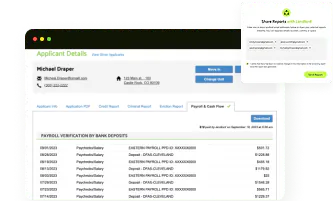
Always use our income verification and cash flow report or a similar verified tool rather than accepting unverified documents at face value. Move-in specials with no credit check are most common when vacancy is high. If you are running one, be clear about what you are substituting for the credit review, and document your screening criteria in writing, regardless.
3. Sublets and Roommate Arrangements
Sublease options and roommate situations reduce your direct exposure to a low-scoring applicant, as the original leaseholder maintains primary responsibility. If you allow subletting, make sure your lease spells out exactly what is permitted and what is not. A sublease that you did not sanction in writing creates complications you want to avoid.
4. Student Housing
University-affiliated housing works differently. These programs typically verify enrollment status and require a parent cosigner instead of running a credit check. If your property is near a campus, lean into that. Make enrollment proof and a parent cosigner your primary screening requirements. It is a straightforward approach that fits the market.
5. Short-Term or Month-to-Month Rentals
Month-to-month leases carry less long-term risk, which is one reason some landlords are more flexible on credit screening for these arrangements. The shorter commitment reduces your exposure if the tenancy goes wrong. The trade-off is higher turnover and the administrative cost that comes with it.
Review the questions to ask before signing a lease to make sure your short-term lease terms are tight enough to protect you.
6. Government or Income-Based Housing
Section 8 and income-based housing programs work differently from standard rentals. HUD sets the eligibility criteria. You do not run a credit screen. Instead, the program verifies income and household size on its end.
The trade-off is straightforward. You follow program rules. In return, you get guaranteed rent payments and tenants who tend to stay longer. Thinking about joining? Contact your local Public Housing Authority. They will walk you through current payment rates and program requirements for your area.
Takeaway: Match your screening approach to your property type and your risk tolerance. A rigid cutoff may be appropriate for a high-demand urban unit. A more flexible review may make more sense for a month-to-month rural rental with a high vacancy rate.
What Landlords Actually Look at Beyond Your Credit Score?

A credit score is a starting point, but experienced landlords and property managers evaluate the full financial and behavioral profile before making a decision. For renters, understanding what else is being assessed helps you build a stronger application. Here is what the complete review actually covers.
Income Consistency vs. Income Amount
How landlords interpret income documents goes beyond checking whether the three-times-rent threshold is met. What matters most is the pattern. A bank statement that shows the same amount arriving on the same days each month is more reassuring than a high annual figure that swings unpredictably.
A freelancer who earned $9,000 one month and $800 two months later creates genuine uncertainty about whether rent will come in on a difficult month. A salaried employee who clears $3,600 every two weeks is easier to evaluate. For self-employed applicants, landlords typically want to see 12 months of bank statements and tax returns to assess the trend rather than a single snapshot.
Bank Balance and Cash Flow Signals
Landlords look at savings and cash flow as indicators of resilience. An applicant with $10,000 in savings applying for a $1,600 unit has a meaningful cushion to absorb an unexpected expense without missing rent. One with $400 in their account on application day does not, regardless of their monthly income.
Beyond the balance itself, landlords watch for behavioral patterns in bank statements: returned payments, recurring overdrafts, and zero-balance months reveal how an applicant manages cash flow under pressure. These patterns often predict payment behavior more reliably than the credit score alone.
Employment Stability
Length of tenure at a current employer is one of the clearest reliability signals a landlord can interpret during screening. Three or more years at the same employer is a strong positive indicator. Frequent job changes in the last 12 months raise questions, even if the current income is solid.
Landlords weigh a recent job change differently depending on context. An applicant who moved from a similar role at a comparable salary is lower risk than one who shifted industries entirely. A proactive applicant who explains the change and provides an offer letter with a confirmed start date is easier to assess than one who submits a form and hopes the gap goes unnoticed.
Behavioral Signals
The tenant screening process extends beyond the documents. How an applicant communicates during the process tells you a great deal. Do they respond promptly? Do they show up on time to viewings? Do they ask informed questions about the lease?
A borderline application from someone who is organized, timely, and transparent often warrants a second look. Our portable tenant screening report lets applicants proactively share verified screening data with you. When a renter comes to you with their screening information already prepared, that transparency is itself a positive signal worth factoring into your decision.
Takeaway: The full picture includes income, savings, employment, and behavior. A complete review gives you far more to work with than a credit score alone.
Common Mistakes Renters With Bad Credit Make
Renters with credit challenges often make predictable mistakes during the application process. Recognizing these patterns helps you read applications more accurately and ask the right follow-up questions.
- Applying without reviewing their own credit report first. Many applicants discover their score is lower than they thought only after receiving a denial. These renters often do not know the difference between a soft and hard credit check, and they have no idea what specific marks are on their file. An applicant who cannot speak to their own credit history in general terms is often less prepared overall.
- Targeting properties outside their range. Applicants with scores below 580 rarely secure a corporate apartment. Those buildings use automated screening with hard cutoffs. No human reviews the file. The application fails before anyone reads it.
When you do speak with these applicants directly, ask whether they understand what is in their report. The ones who can explain their marks clearly and point to what has changed since then are worth a closer look. The ones who cannot are often still guessing. - Leaving derogatory marks unexplained. A collections account with no context leaves you to draw your own conclusions. An applicant who provides a clear letter of explanation with documentation gives you actual information to evaluate. The ones who say nothing leave you with less reason to take a risk.
- Hiding their credit situation upfront. Some applicants wait for you to pull the report rather than disclosing their score during the initial conversation. The ones who mention it early and explain the circumstances are often the more accountable applicants. Silence on this point is worth noting.
- Submitting applications randomly without a strategy. Some applicants apply to every available listing at once. Each application triggers a hard inquiry. Stack enough of them in a short window, and the score drops further. An applicant who scored five points lower on approval day than on application day was not managing their credit carefully. That pattern tells you something worth noting.
Check how often a credit score updates if an applicant tells you their score has recently improved, and they want you to pull a fresh report. Also, understand the difference between a credit score and a credit report when reviewing an application. The report tells you the full story. The score is just a summary.
Conclusion
Can you get an apartment with bad credit? As a landlord, the better question is whether you can identify which low-score applicants are genuinely reliable. The answer, in many cases, is yes. A thorough screening process that goes beyond the number and looks at income consistency, savings, employment history, and behavior gives you far more to work with than a cutoff alone.
Set written criteria before screening begins. Require the right documentation. Use verified income and screening tools. Take the time to call prior landlords and read the full credit report rather than just the score. The applicants who pay on time despite a low score are out there. A complete review is how you find them.
FAQs
1. Can You Rent an Apartment With a 500 Credit Score?
Renting with a 500 credit score is difficult through most standard screening processes. As a landlord, approving an applicant at this level carries real risk unless they can demonstrate strong compensating factors.
Consistent income well above the three-times-rent threshold, significant savings, a qualified cosigner, and clean references from prior landlords are the combination most likely to justify the decision. Document your reasoning in writing before approving.
2. How Much Deposit Is Required With Bad Credit?
There is no universal rule, but landlords commonly require a deposit of two to three months' rent when an applicant's credit score falls below 620. State law determines the maximum you can legally collect. Check your state's landlord-tenant statutes before adding deposit conditions to any offer. Requiring more than the legal cap creates liability regardless of your intent.
3. Do You Need a Cosigner to Rent With Bad Credit?
Not always. A co-signer for an apartment significantly reduces your risk when you are approving a low-score applicant. A cosigner who meets your credit and income standards takes on legal responsibility if the primary tenant defaults.
Set clear thresholds for cosigners, usually 680 or above, with independent income covering the rent. A guarantor rental arrangement can work similarly. Know the legal difference between the two before you put either in writing.
4. What Documents Prove Income for Renting?
- Pay stubs from the most recent two to three months
- Bank statements showing consistent monthly deposits
- An employer verification letter confirming the applicant's role and pay
- Tax returns for self-employed applicants
- An offer letter if the applicant recently started a new position
Most rental application requirements use several of these together to confirm that the rent-to-income ratio meets the minimum threshold you set.
5. Are No-Credit-Check Apartments Safe?
For landlords who run them, no-credit-check arrangements shift the risk entirely onto income verification. That is manageable if your verification process is thorough. Use verified tools rather than accepting documents at face value.
Understand the full apartment rental process implications of removing the credit check before you make it standard practice. For some property types and markets, it is a reasonable trade-off. For others, it adds exposure that the rental income does not justify.
Disclaimer: The information provided in this post is intended for general informational and educational purposes only. It should not be construed as legal, accounting, or tax advice. For guidance specific to your situation, we recommend consulting with a qualified professional in the relevant field before taking any action based on the content provided.