The rental screening science score (RS³) answers a question traditional credit scores were never built to address: can this applicant afford this specific rent, at this property, right now? Two applicants for the same $2,000 unit. Both clear the standard 3x-income rule. Both hold credit scores in the low 700s. On paper, a landlord has no way to tell them apart. The first keeps roughly $9,000 in checking, with payroll landing on the 1st and the 15th like clockwork. The second earns slightly more, but the balance drops under $300 before every payday, with four overdrafts in the last six months. Traditional screening approves both, because it never looks at the account the rent will actually come from. RS³ does — and scores them apart.
The rental screening science score closes (RS³) that gap. This guide breaks down what RS³ means, how it gets calculated, and how a landlord reads it against a real tenant screening report. Renters get answers, too, including how the score carries over from one application to the next.

What Is the Rental Screening Science Score (RS³)?
The rental screening science score (RS³) is built from four data sources traditional credit reports ignore: verified income, rental application data, the exact rent amount of the property, and real-time bank account activity. The score is designed to predict one specific risk: what is an applicant’s predicted rental default rate at this price right now. Then it outputs a score from 300 to 850. The difference is this: the rental screening science score adjusts to each property's rent, so the same applicant scores differently depending on the lease's affordability.
Here is where LeaseRunner's use of the rental screening science score separates from traditional credit scoring. A traditional credit score ignores both income and rent. It stays frozen whether the applicant earns $3,000 or $30,000, and whether they are renting a $1,500 unit or a $4,000 one. The rental screening science score does not. It asks whether this income, this bank balance, and this rent align, so the same person can be a low-risk tenant at one property and a higher-risk one at another.
A better example shows why. Take an applicant with $6,000 monthly income and $1,200 in the bank.
- Unit A: rent $1,800 (30% of income, looks safe by traditional standards). But the first month's rent consumes the entire bank buffer, leaving zero cushion for an emergency. The rental screening science score flags this as moderate risk.
- Unit B: rent $2,200 (37% of income, looks worse on a spreadsheet). But the applicant has received three recent bonuses and maintains a 90-day average balance of $8,000. The rental screening science score reads this as low risk because the cash balance is there.
A traditional rent-to-income ratio would rank Unit A as safer. But the rental screening science score, reading live bank data, sees the real story: one has a thin safety net, one does not. Same person, same day, two different affordability realities. That is the score landlords have wanted for years.
Why Do Landlords Need a Rental-Specific Credit Score?

Traditional credit scores were built to grade loans, not rent. They score how someone handles credit cards, car loans, and mortgages. They never see the rent, the income, or the bank balance behind a lease. The traditional credit score is not based upon other metrics besides rental payment default. That is a different risk, and what landlords look for in a credit check rarely maps cleanly onto it.
Rent default is expensive. When a tenant stops paying, the landlord absorbs lost rent, turnover costs, and legal bills. One eviction costs between $3,500 and $10,000 once all expenses are accounted for. For a small owner with one or two units, a single bad approval can erase a year's profit.
The market is huge and mostly consists of small landlords. The United States held about 45.9 million renter-occupied homes at the end of 2025.
Individual investors own 37.6% of all rental units nationwide — but 70.2% of units in small rental properties (four units or fewer), which is where most independent landlords operate (Source: CRS Report R47332). These owners screen without a research team behind them. They need a rental screening score that speaks in rent-default odds, not loan-default odds.
All in all, the credit score on the report is not the rent-risk answer. Pair it with a rental-specific number like the rental screening science score, and the approve-or-deny call rests on the risk that actually threatens the rent roll.
How Is the RS³ Score Calculated?
The rental screening science score (RS³), developed by RS3 Ltd., scores an applicant on rent payment default itself, built from real rental payment data rather than borrowing history.
RS³ is trained on the outcome landlords fear most: unpaid rent. RS³ analyzed hundreds of thousands of ACH rent payments across all 50 states and more than 2,000 zip codes, drawn from over 1,000 U.S. banks. The screening algorithm learned which financial patterns precede a missed payment, then scored for that specific risk. The factors that affect the rental screening score fall into four groups:
- Income. RS³ reads verified income, mostly from direct deposits, to size up steady earning power.
- Rental application data. Employment status, occupants,, and other data all affect the applicant's risk score.
- The rent amount. The exact rent turns the score into an income-to-rent ratio scoring signal, so affordability is baked in.
- Banking metrics. Live bank data is a consistent and reliable data source. .
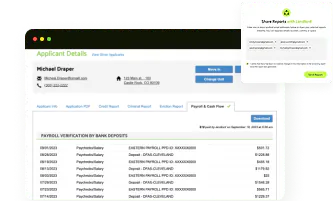
Those banking metrics include the account type, available balance, average and current balances, total credits and debits, payroll deposits, overdrafts, and returned checks, as well as the first and last dates of account activity. Together, they show how money actually moves, not just how debt was handled years ago. That is the core of how RS³ calculates a rental screening score.
Because LeaseRunner's rental screening science score studies real rent defaults, its output ties straight to the question on every lease: will this rent get paid?
Why Does RS³ Use Bank Data Instead of Traditional Credit Reports?

Bank data is closer to the rent than any credit file. Three reasons explain why the rental screening science score leans on it.
Nearly All Rent Is Paid from a Bank Account
Every dollar of rent ends up in a bank account eventually, whether it was written as a check, sent by card, or handed over in cash. Even a tenant who pays in cash withdrew it from somewhere, most likely a bank. Credit card payments get pulled from a bank account days or weeks later. Most income arrives by direct deposit straight into a checking account. So when you want to know whether someone can pay rent, bank activity gives you the clearest picture.
In practice, a bank balance on the first shows real ability to pay, while a credit score only hints at it.
Bank Data Is More Reliable and Up to Date
Credit reports sit in a queue. They update monthly or after a major event. Bank data updates every single day. When LeaseRunner pulls bank metrics through a secure API, it sees balances, deposits, and spending from the past week, not the past quarter. The numbers stay in the same format across almost every U.S. bank, so the rental screening science score can read dozens of data points at once without guessing or translating.
Real-time cash flow catches problems that a months-old credit file would miss.
No False-Positive Matches
Here is the strongest advantage. Bank data ties to one real account. Credit reports and public records get tangled on common names and shared addresses, dragging the wrong person's history onto an innocent applicant. Bank verification works differently. It confirms exactly which person owns which account, so an honest applicant does not get penalized for a stranger's missed payment or legal trouble.
Fewer false flags mean fewer good tenants wrongly denied and a fairer tenant screening process overall.
How Is RS³ Different from a Traditional Credit Score?
A traditional credit score and the rental screening science score answer different questions. The biggest difference is this: traditional scores measure borrowing behavior across all properties at a fixed level, while the rental screening science score adjusts to the exact rent and property, so it answers whether this applicant can afford this lease. For a landlord, that means one score that actually predicts rent risk, not a generic number that works for mortgages and car loans equally.
Both numbers share the same tenant screening score range, 300 to 850, so the scale feels familiar. The data engine underneath is what changed. Rental-specific scores are not brand new either. Other platforms offer rental-specific alternatives, typically graded on a similar scale. The rental screening science score goes further by adjusting to the exact rent and reading live bank data daily instead of relying on monthly bureau updates.
The credit score still has its place in a landlord's toolkit, but for the pay-the-rent question, the rental screening science score answers more directly.
How Can You Use Your RS³ Score as an Applicant?

For renters, LeaseRunner's rental screening science score lives inside a portable report that travels from one application to the next.
An applicant meets RS³ inside LeaseRunner's portable tenant screening report. The report shows the renter's score, default risk, and income percentile in one place. A tenant fills it out once, then shares the same report with several landlords. There is no new credit pull per showing, and the report stays reusable for 30 days.
That portability saves money and time. A renter can check their tenant screening report before applying, fix any surprises, and walk into a showing with proof of income and affordability ready. Because RS³ pulls bank data via a soft inquiry, reviewing it does not affect the applicant's credit.
For a renter, one strong rental screening science score report can carry a tenant through a whole apartment search, especially when a thin credit file would otherwise hold them back.
Common Use Cases of RS³ in Tenant Screening
LeaseRunner's rental screening science score helps most where a traditional credit score goes quiet or gives a misleading read. Renters with no credit history, gig workers with uneven income, mid-range credit scores, and applicants applying to multiple properties all face screening gaps that traditional scores cannot fill. In each case, a rental screening science score answers what credit cannot: whether someone can actually afford this rent, right now.
Renters with No Credit History or a Thin File
Young renters and newcomers often have no credit file to score. A credit bureau cannot rate what it has never seen. LeaseRunner's rental screening science score scores them anyway, straight from bank activity, income, and cash flow. A steady paycheck and a healthy balance speak louder than a blank credit record.
The upshot: a thin file is no longer an automatic unknown, since RS³ turns bank history into a real risk assessment score.
Gig Workers and Self-Employed Renters
Freelancers, drivers, and shop owners earn real money in an uneven rhythm. Traditional scoring struggles with that. Rental screening science score reads deposit trends, cash flow, and average balances, so lumpy income still tells a clear story. A rideshare driver with strong monthly deposits can score well without a W-2.
Put simply, irregular income is not the same as risky income, and RS³ helps distinguish between the two.
Renters with a 500–650 Credit Score
A mid-range credit score leaves landlords guessing. Is a 610 a real risk or just an old medical bill? The rental screening science score adds the missing context by checking whether income and bank balances cover today's rent. That makes renting to tenants with lower credit scores a measured call instead of a coin flip.
A middling credit score paired with a strong rental screening science score often points to a safe approval that a blunt credit cutoff would have rejected. The applicant may have old debt or a rough patch, but if the income flows steady and the bank balance sits healthy, they can carry the rent.
Applicants Applying to Multiple Properties
An applicant touring five units should not pay for five separate screenings. With RS³ inside a portable report, one score follows them to every landlord. Each landlord still sees a fresh, tamper-proof read of income and affordability.
The business case: portable RS³ speeds up the pipeline, so good applicants sign before a competitor's vacancy grabs them.
How Do Landlords Use RS³ in Screening?

The rental screening science score is licensed exclusively to LeaseRunner, so landlords reach it through one platform, alongside the rest of the screening picture. This is the heart of how landlords use screening scores day to day.
Since LeaseRunner has the solution, the platform is the sole source of the number. A landlord orders screening, the applicant consents, and RS³ arrives with the report.
The rental screening science score is one layer, not the whole decision. Smart landlords weigh it alongside background records, eviction history, rental application data, and any red flags in a background check. The score sharpens the screening score and approval decision, but it does not replace judgment or the full report.
Cost matters too, especially for small owners. The rental screening science score sits inside LeaseRunner's screening at a price built for independent landlords, and how much tenant screening costs stays transparent and per applicant. Every landlord must also follow the Fair Credit Reporting Act (FCRA), since a score-based denial counts as an adverse action. LeaseRunner handles the consumer reporting agency side of that process.
A rental-specific score gives a clearer read of rent risk, but a defensible approval still blends the score with the full background report and proper FCRA steps. This multi-layer approach protects the landlord and gives the applicant a fair evaluation based on more than a single number.
How to Read an RS³ Score for a Specific Rent
Because the rental screening science score moves with the rent, a landlord reads it against the exact price of the unit on offer.
Read the rental screening science score at the rent that matters: your own unit. A high score on a $1,400 apartment means the applicant's income and bank balance carry that rent with room to spare. The same applicant may score lower on a $3,000 unit, and that lower number is not a red mark on the person. It is an honest read of affordability at that price.
A landlord sets an approval threshold tied to the actual rent, not a blanket credit cutoff. A 720 credit score on an unaffordable unit is a weaker bet than a solid rental screening science score that already accounts for the rent. So what is a good rental screening score? On the 300 to 850 scale, higher is safer, but the honest answer depends on the rent. A score that covers your unit's rent with a margin is a good score for that unit.
Landlords who want this rent-aware read can screen applicants with LeaseRunner's rental-specific score and pull the rental screening science score inside a full report. The score, the default risk, and the affordability read arrive together, ready for a confident yes or no.
Matching the score to the actual rent turns an approval or denial into a decision grounded in this property, not a generic average. A landlord stops guessing about affordability and starts deciding on data that actually fits the lease.
Conclusion
The rental screening science score finally measures renters' risk to landlords, based on unpaid rent at a specific price. RS³ reads income, application data, the rent amount, and live bank data, then delivers a 300 to 850 score that shifts with the rent. That design captures good tenants that a traditional credit score would miss, from thin-file renters to gig workers, while flagging real affordability gaps that a frozen number would hide.
For the millions of independent landlords screening on their own, a rental-specific score means fewer costly evictions and fewer good applicants turned away by mistake. LeaseRunner uses RS³ for exactly that job, and it lives inside the same report landlords already trust for confident leasing decisions.
Frequently Asked Questions
1. What does RS³ stand for?
RS³ stands for rental screening science score. It is LeaseRunner's rental credit score, scaled from 300 to 850, built to predict rent payment default rather than loan default. The RS³ meaning is simple: a science-backed read on whether an applicant can afford a specific rent amount.
2. How is RS³ different from a credit score?
A credit score grades loan and credit card behavior, and it never changes with the rent. RS³ studies real rental defaults and adjusts to the exact rent amount, using live bank data instead of only credit bureau history. One measures borrowing, the other measures rent affordability.
3. Does RS³ use a hard credit inquiry?
No. RS³ relies on bank data and a soft inquiry, so checking it does not lower an applicant's credit score. A renter can review their score freely and share it with several landlords without any credit hit.
4. Is It Safe to Connect Your Bank Account?
Yes. LeaseRunner uses time-tested, secure, read-only bank connections and encryption to gather the metrics behind RS³, and it does not store login details. The connection reads balances and transaction patterns only and never moves money, which keeps the tenant screening process private and safe.
Disclaimer: The information provided in this post is intended for general informational and educational purposes only. It should not be construed as legal, accounting, or tax advice. For guidance specific to your situation, we recommend consulting with a qualified professional in the relevant field before taking any action based on the content provided.