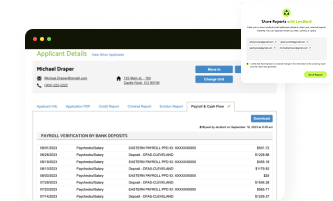
A portable tenant screening report by state depends entirely on local law. As of 2026, only a handful of states require or regulate landlord acceptance of a reusable screening report, while many others leave the decision to individual landlords. Understanding your state's rules helps tenants avoid unnecessary application fees and helps landlords remain compliant with state-specific screening regulations.
Whether you are applying for an apartment or reviewing rental applications, knowing which states require portable tenant screening reports is the first step toward complying with modern rental screening laws.
Which States Have Portable Tenant Screening Report Laws?

Only several states have enacted portable tenant screening report (PTSR) laws or related fee-waiver statutes as of July 2026. Colorado and Washington remain the most established examples, while Illinois, California, Maryland, Rhode Island, and New York have adopted narrower consumer protection rules or optional acceptance frameworks.
Most states still allow landlords to decide whether to accept a tenant-paid screening report. As a result, PTSR laws vary significantly by state regarding eligibility, validity windows, delivery channels, and enforcement liabilities.
1. Colorado
Colorado has the most comprehensive portable tenant screening report law in the United States. Under C.R.S. §§ 38-12-903–904, a residential landlord generally must accept a qualifying Colorado portable tenant screening report rather than require the applicant to purchase another screening report. When a tenant provides a qualifying report, the landlord also cannot charge an application screening fee or a fee to access the report.
House Bill 23-1099 established Colorado's statewide PTSR framework. House Bill 25-1236, effective January 1, 2026, updated several compliance requirements for both landlords and tenants.
Key changes under HB25-1236:
- Credit exemptions: Applicants using housing subsidies may omit a credit report, credit score, and adverse credit events from a qualifying PTSR.
- Delivery flexibility: HB25-1236 repealed the provision allowing landlords to require delivery directly through a consumer reporting agency or third-party website. Applicants may submit a qualifying PTSR directly to the landlord, although landlords may still verify the report with the issuing consumer reporting agency.
- Fee restrictions: A landlord may not charge an application fee or a fee to access a qualifying portable tenant screening report.
Colorado law also includes an enforcement mechanism for violations. A landlord who fails to comply may be liable for actual damages or statutory damages of $2,500, plus court costs and reasonable attorney fees. However, if the landlord cures the violation within 7 calendar days after receiving written notice, statutory damages are reduced to $50.
2. Illinois
This Illinois portable tenant screening report must fulfill four strict conditions simultaneously: prepared within the prior 30 days, issued by a consumer reporting agency, paid for by the applicant, and made available to the landlord at zero cost. Landlords retain the right to refuse the report and run independent background checks, but local municipal ordinances providing stronger tenant protections will override the state baseline.
3. New York
New York does not mandate the acceptance of portable reports as a replacement for a landlord's internal screening criteria. NY RPL § 238-a simply establishes a fee bypass mechanism. Landlords cannot charge their standard background check fee (capped at $20) if an applicant provides a copy of a background/credit check run within the past 30 days. Landlords retain full authority over their evaluation policies.
4. Rhode Island
Rhode Island stands out for validity period alone: a Rhode Island portable tenant screening report stays usable for up to 90 days, triple the 30-day window most other states allow. Rhode Island law does not force a landlord to accept every report, but it does bar landlords from charging an application fee once a qualifying report is on the table, and any denial based on the report still triggers an FCRA adverse-action notice.
5. Washington
Washington regulates portable tenant screening reports through disclosure requirements rather than mandatory acceptance. Under RCW 59.18.257, a landlord advertising a rental property online must clearly state whether the property accepts a comprehensive reusable tenant screening report before accepting an application. A landlord may still decide whether to accept the report, but failing to provide the required disclosure may result in statutory damages of up to $100, plus court costs and reasonable attorney fees.
Washington continues to serve as a model for disclosure-based Washington PTSR laws.
6. District of Columbia
Washington, D.C. has also been identified as a jurisdiction to watch as policymakers continue discussing tenant screening reforms, although no comparable statewide PTSR law is currently in effect there.
7. California
California's AB 2559, codified at Civil Code § 1950.1, makes acceptance entirely voluntary-the statute says so explicitly. A landlord who opts in must post clear notice on every listing, website, application form, and physical leasing office, and once opted in, that landlord cannot charge a screening fee to an applicant who provides a qualifying report. Large metros such as Los Angeles and San Diego have enough participating landlords that a renter with a California portable tenant screening report can often find one willing to accept it.
8. Maryland
Maryland's RP § 8-218 sits in the same notice-conditional tier as Washington. A landlord must tell applicants upfront whether reusable reports are accepted, and a qualifying report must be prepared within 30 days and include a credit report, a seven-year criminal and eviction history for each prior jurisdiction, employment and income verification, and current address history. Once a landlord opts in, that landlord cannot charge an access fee or an application fee for a compliant report.
9. Florida
Florida has no statewide portable tenant screening report law as of mid-2026. House Bill 43 was withdrawn earlier in the legislative cycle, and Senate Bill 48-which briefly carried reusable-screening-report language before an amendment stripped it out over data-security concerns - died in the House on March 13, 2026. A Florida portable tenant screening report still has value for cutting down repeat application fees, but no state law forces a Florida landlord to accept one.
10. San Diego, California
San Diego does not layer a separate municipal PTSR ordinance on top of state law. Screening in the city runs under California's AB 2559 alongside the local Tenant Protection Ordinance, so a San Diego landlord follows the same voluntary opt-in rule that applies statewide - nothing more, nothing less, despite periodic proposals the National Apartment Association has flagged as jurisdictions to watch.
Why Do Portable Tenant Screening Report Laws Vary by State?

Portable tenant screening report laws vary because state legislatures balance renter affordability against landlord fraud concerns. Colorado led the reform movement in 2023, prompting other states to adopt similar measures with different levels of landlord obligation.
- Renter advocacy: States with strong tenant unions (Colorado, California, Illinois) passed PTSR laws to reduce duplicate application fees.
- Landlord lobbying: States with powerful property owner associations (Florida, Texas) opted for voluntary acceptance rather than mandates.
- FCRA alignment: All PTSR laws must comply with the federal Fair Credit Reporting Act, which governs how consumer reporting agencies handle tenant data.
- Local housing crises: High-cost rental markets (New York, California, Washington) adopted PTSR laws to ease application burdens on renters.
Federal attention exists too-comments from 15 state attorneys general to the FTC, along with a 2023 White House fact sheet on rental junk fees, pointed to portable screening report laws as a primary lever for lowering application costs, but the federal government has left direct legislative implementation to individual states.
Are Landlords Required to Accept a PTSR?
Whether landlord acceptance of a portable report is mandatory depends entirely on which of the three tiers a state falls into. Only Colorado mandates landlord acceptance of a portable tenant screening report. Other states allow landlords to choose whether to accept reusable reports, but impose fee-waiver rules if they do.
- Mandatory acceptance: Colorado (HB23-1099).
- Optional acceptance with fee waiver: Illinois, California, Washington, Maryland, Rhode Island, New York.
- No PTSR law: Florida, Texas (as of 2026).
Landlords in optional-acceptance states must clearly disclose their PTSR policy in rental listings and applications.
What Makes a PTSR Valid in Your State?
A portable screening report's validity period, delivery method, and data content must align with state requirements before a landlord has any legal obligation to honor it.
1. The 30-Day Standard and Its Exceptions
Most states require a PTSR to be generated within 30 days of submission,, while Rhode Island allows up to 90 days:
- 30-day standard: Illinois, California, Washington, Maryland, New York, Colorado
- 90-day exception: Rhode Island
A report older than the state's validity window does not qualify for fee waivers or mandatory acceptance.
2. Direct Delivery (The Anti-Fraud Rule)
Several statutes - Illinois and Maryland among them - define a qualifying report as one "made directly available" to the landlord by the consumer reporting agency, a structure designed to keep a tenant from editing or forging a PDF before forwarding it. Colorado moved in the opposite direction in 2026: HB25-1236 repealed the requirement that reports flow only through the agency or a designated portal, so a Colorado landlord must now accept a report delivered straight from the applicant.
Industry groups such as the Apartment Association of Metro Denver have flagged that change as a fraud risk, and Colorado law still gives the landlord the right to contact the issuing agency directly to confirm authenticity.
3. Core Data Requirements
A valid PTSR must include five key data fields mandated by state law. Missing any field can invalidate the report.
- Full legal name
- Contact information (phone, email, current address)
- Employment and income verification
- Eviction history (state and local, 7-year lookback in Maryland)
- Criminal background check (federal, state, local; 7-year lookback in Maryland)
Every qualifying report has to come from a consumer reporting agency operating under FCRA rules - a landlord's own background check or a free online lookup does not count as a portable screening report law compliant document.

4. Zero Retrieval Costs
Once a report qualifies, the landlord cannot pass along a fee to access it, and cannot charge a separate application screening fee on top of it. That rule holds across every mandatory and notice-conditional state; the tenant-paid screening report model only works if the landlord side stays free.
No true free portable tenant screening report exists for the applicant, since a compliant report still has to come from a paid consumer reporting agency - the "free" part of the law only ever applies to the landlord's side of the transaction.
What Are the Compliance Risks for Landlords Under State PTSR Laws?
Getting the process wrong costs more than a rejected application - several states attach real financial penalties to noncompliance.
Notice & Disclosure Obligations
California, Maryland, and Washington all require upfront, conspicuous notice of a landlord's acceptance policy, posted on listings, websites, applications, and physical leasing locations. Skipping that notice, or burying it somewhere an applicant would not reasonably see it, counts as a violation even if the landlord's underlying policy is otherwise lawful.
Penalties for Non-Compliance
Colorado imposes the strictest penalties, allowing statutory damages of up to $2,500 per violation, plus court costs and reasonable attorney fees. Washington provides a lower statutory remedy of up to $100, along with court costs and reasonable attorney fees, for disclosure violations. Illinois does not specify a fixed statutory penalty, leaving enforcement to general civil remedies rather than a predetermined damages amount.
The takeaway is simple: landlords should understand their state's PTSR requirements before collecting screening fees or declining a qualifying report, as the consequences for non-compliance vary significantly by jurisdiction.

What's the Difference Between State PTSR Requirements?
Portable tenant screening report laws share the same goal—reducing duplicate screening costs—but each state takes a different approach. The biggest differences involve how long a report remains valid, whether landlords can choose their screening provider, and how states protect against fraud.
Expiration Windows
Most states require a portable tenant screening report to be issued within the previous 30 days. Colorado and Rhode Island provide longer validity periods under specific circumstances.
Platform Freedom and Provider Restrictions
Most states allow tenants to use any FCRA-compliant consumer reporting agency. Landlords cannot force tenants to use a specific platform.
- Open platform: Colorado, Illinois, California, Washington, Maryland.
- No restrictions: Tenants can use LeaseRunner, Avail, TransUnion, Experian, etc.
The One (Almost) Universal Rule
Although state laws differ, most follow the same anti-fraud principle: a portable tenant screening report should originate from an FCRA-regulated Consumer Reporting Agency, allowing landlords to verify that the report has not been altered.
Colorado's 2026 amendments provide greater flexibility by allowing applicants to submit qualifying reports directly rather than through a required delivery platform. Even so, landlords may still verify the report with the issuing CRA before relying on it.
Understanding these differences helps landlords apply the correct screening process while avoiding unnecessary fees or compliance issues. For tenants, checking each state's requirements before applying can help reduce duplicate screening costs and prevent delays during the rental application process.
Conclusion
Portable tenant screening reports are reshaping rental applications across the U.S., with Colorado leading mandatory acceptance and seven other states adopting fee-waiver or disclosure rules. Landlords must understand state-specific validity periods, disclosure obligations, and delivery requirements to avoid penalties.
LeaseRunner helps landlords and tenants navigate portable tenant screening report laws with FCRA-compliant reports, multi-state validity tracking, and direct CRA-to-landlord delivery.
FAQs
Q1. Does every state require landlords to accept a PTSR?
No. Only Colorado mandates landlord acceptance of a portable tenant screening report. Other states (Illinois, California, Washington, Maryland, Rhode Island, New York) allow optional acceptance with fee-waiver rules.
Q2. Which state was first to mandate PTSRs?
Colorado was the first state to enact a statewide portable tenant screening report law. House Bill 23-1099 took effect on August 7, 2023, establishing the country's first mandatory PTSR framework. House Bill 25-1236 later updated the law, effective January 1, 2026.
Q3. Can I use the same PTSR in a different state?
Yes, if the report meets the receiving state's validity and data requirements. A 30-day-old PTSR from Colorado can be used in California, but a 45-day-old report would not qualify. Always check the target state's expiration window.
Q4. Are PTSR laws the same across all cities in a state?
No. Some cities (e.g., San Francisco, Seattle) have stricter local screening ordinances that override state law. Always verify city-specific rules in addition to state requirements.
Q5. Where can I find the PTSR law for my specific state?
State legislature websites publish the full statutory text, and a state-by-state breakdown of how much a portable tenant screening report costs and requires is the fastest way to confirm current rules before applying or leasing.
Disclaimer: The information provided in this post is intended for general informational and educational purposes only. It should not be construed as legal, accounting, or tax advice. For guidance specific to your situation, we recommend consulting with a qualified professional in the relevant field before taking any action based on the content provided.