How much is a portable tenant screening report in 2026? Renters who apply to 5 apartments often pay a $50 application fee per apartment. The total reaches $250 before a single lease offer arrives. A portable tenant screening report (PTSR) cuts that bill to one flat screening fee. One reusable tenant screening report can be used across multiple landlords and property managers.
The guide below breaks down every cost factor. Each section compares the cost of the portable tenant screening report with the cost of traditional per-application screening. Renters and landlords alike will see exactly where to get a portable tenant screening report without overpaying.

Average Cost of a Portable Tenant Screening Report (Quick Answer)
Most renters pay between $30 and $65 for a comprehensive portable tenant screening report. The exact tenant screening report price depends on the provider and the depth of data included. On the lower end, a basic report covering only a credit report and eviction record starts around $30. Full-package reports that bundle a criminal background check, income verification report, rental history, and identity confirmation cost $60 or more.
The LeaseRunner PTSR costs $41 per applicant aged 18 and older. That one-time screening fee grants renters a shareable link valid for 30 days. Other providers charge between $35 and $60 for similar coverage. According to the Upturn policy research group, at least five vendors currently offer reusable reports at price points ranging from roughly $32 to $65.
What does this mean for landlords? A renter who arrives with a paid PTSR saves the landlord time in processing. The landlord receives a verified snapshot without having to order a separate screening. For renters, the average cost of a tenant screening report remains fixed regardless of how many landlords view it during the 30-day window.
Cost aside, several factors push the final price up or down. The next section breaks down all the variables that determine how much a portable tenant screening report costs.
What Determines the Cost of a Portable Tenant Screening Report?

Not every portable tenant screening report costs the same. Three main factors drive the final number: the data types included, optional add-ons, and the provider's pricing model.
Type of Data Included
The cost of a tenant screening report rises with the depth of information pulled. A basic report might only include a credit report and a background check. A premium report adds eviction history, criminal background check results, and rental history verification. Here is what each data type typically adds:
- Credit score and credit report: $9 to $15 alone. The report shows payment patterns, open accounts, and any collections. Landlords rely on credit data to gauge financial responsibility and predict on-time rent payments.
- Criminal background check: $10 to $25, depending on county-level vs. national searches. National searches cost more but cover moves across state lines. Landlords use criminal data as part of a broader tenant screening process governed by the Fair Credit Reporting Act.
- Eviction history report: $7 to $15. Court records reveal past filings and judgments. Even a dismissed filing can signal risk. Renters who want to dispute an eviction on a tenant screening report should check the data before sharing the PTSR.
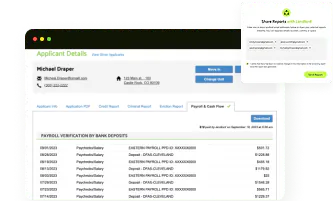
- Income verification report: $10-$20. Automated cash flow tools pull bank deposit data to confirm affordability. Manual methods (pay stubs, HR calls) take longer and vary in cost.
A report that bundles all four categories costs more upfront but delivers far greater accuracy of tenant screening data.
Add-Ons
Some providers charge extra for features beyond the core report:
- Identity verification: Matches a government ID to credit bureau records. Adds $3 to $10.
- Expedited reports: Rush processing delivers results in minutes instead of hours. Adds $5 to $15.
- Income verification: When not included in the base package, bank-linked income verification costs $10-$20.
Renters should confirm what the base portable tenant screening report cost covers before purchasing. A $30 report missing eviction records may force a renter to buy a second, more complete version.
Provider Pricing Models
Different providers structure fees in different ways:
- Flat fee: One price covers everything. The LeaseRunner PTSR service uses a flat $41 fee that includes credit, criminal, eviction, and income data.
- Tiered pricing: Base reports cost less, but each added data type costs extra. Renters pick and choose. The total can exceed flat-fee options if renters need full coverage.
- Tenant-paid vs. landlord-paid: In many cases, the renter pays the PTSR fee directly. Some landlords cover the screening fee themselves when running traditional reports. State tenant screening laws determine who can pay and how much they can charge.
Understanding pricing models helps renters pick the most cost-effective option. Landlords benefit too, because knowing what a renter paid helps gauge the completeness of the report. The real value of a PTSR becomes clear when compared against the cost of paying per-application screening fees. The next section runs those numbers.
How Much Renters Save Compared to Paying Per Application?

Paying per application adds up fast in competitive rental markets. A renter applying to five properties at $40 to $50 each spends $200 to $250 on screening fees alone. A single portable tenant screening report eliminates that pile-up.
Consider a real scenario. A renter in Denver applies to seven apartments in one month. At $45 per traditional application, the total is $315. With a $41 LeaseRunner PTSR, the same renter covers all seven applications at a flat cost, saving $274.
The savings scale with the number of applications:
- 2 applications: Traditional cost = $90. PTSR cost = $41. Savings = $49.
- 5 applications: Traditional cost = $225. PTSR cost = $41. Savings = $184.
- 10 applications: Traditional cost = $450. PTSR cost = $41. Savings = $409.
These figures assume a $45-per-application screening cost. In high-demand cities, individual application fees can reach $75 per property, further boosting savings.
What does this mean for landlords? Tenants who arrive with a PTSR are often more serious applicants. Paying once signals commitment. Landlords who accept portable reports also attract a wider pool of renters, as cost-conscious renters prefer properties that do not stack fees.
For renters wondering whether a portable tenant screening report is worth it, the math speaks for itself. Anyone applying to more than one property during a 30-day window saves money with a reusable report compared to the traditional model. To explore the full breakdown of traditional apartment screening fees, landlords can review what a typical apartment background check includes and its costs. But who actually foots the bill? The answer varies by state and situation.
Who Pays for a Portable Tenant Screening Report?
The tenant screening fee is borne by the renter in most PTSR transactions. The renter orders the report, pays the one-time screening fee, and shares the results with landlords.
In traditional screening, the payment structure differs. Landlords sometimes absorb the cost and roll the expense into operations. Other landlords charge an application fee to cover the screening fee, passing the cost directly to the applicant.
The Fair Credit Reporting Act requires written consent from the renter before any consumer reporting agency pulls data, regardless of who pays for it. State law also shapes who pays:
- In Colorado, landlords must accept a valid PTSR and cannot charge an additional application fee when a renter provides one (Colorado HB25-1236). Renters looking for a Colorado portable tenant screening report pay once and skip repeated fees.
- In New York, total screening fees cannot exceed $20, whether the tenant or the landlord pays them. Renters who provide a valid report within 30 days block any extra charge.
- In Washington, landlords must disclose whether they accept reusable reports. If they do, charging a separate screening fee is prohibited.
The landlord takeaway: Accepting a PTSR shifts the cost burden to the renter while still delivering verified data. The landlord skips the administrative work of ordering, processing, and billing for a report. Both sides save time, and the approval process moves faster.
Knowing who pays is one piece. Knowing how long the report stays usable is another.
How Long Is a Portable Tenant Screening Report Valid?
A portable tenant screening report remains valid for 30 days in most states. During that window, renters can share the same report with an unlimited number of landlords and property managers. Rhode Island is the exception. State law allows renters to reuse a report for up to 90 days, giving applicants a window 3 times the standard.
- Why 30 days? Credit activity, employment changes, and new court filings can alter a renter's profile. A 30-day limit balances reusability with data freshness. Landlords who receive a report dated 28 days ago still get reasonably current information. A report older than 30 days, however, may miss a recent eviction record or a sudden drop in credit report scores.
- Practical tip for renters: Start the apartment search before ordering the PTSR. Identify target properties first. Then purchase the report and begin submitting applications. Ordering too early wastes the 30-day clock on properties not yet ready to review applications.
- Practical tip for landlords: Check the report date immediately. A PTSR dated 29 days ago is technically valid, but may warrant a quick follow-up question about any material changes since the report date.
Even with a valid report in hand, renters face costs beyond the sticker price. The next section covers expenses most applicants overlook.
Hidden Costs Most Renters Don't Consider (And How to Avoid Them)

The listed cost of the portable tenant screening report only tells part of the story. Several indirect expenses catch renters off guard during the rental application process.
Paying Multiple Screening Fees Without a Portable Report
Renters who skip the PTSR and rely on traditional screening pay a separate application fee at every property. In competitive markets like Austin or Seattle, renters commonly apply to eight or more units in a single month. At $50 each, the total reaches $400 before a lease is ever signed.
How to avoid this: Order one reusable tenant screening report at the start of the apartment search. A single $41 fee replaces hundreds of dollars in stacked per-application screening costs. Understanding what a tenant screening report includes helps renters confirm the PTSR covers everything landlords expect.
Rejection Cost in Competitive Markets
Every rejection carries a price. Beyond the lost screening fee, renters lose time researching the property, touring the unit, and completing the rental application. In hot markets, a rejected application may mean the next best option is already leased.
How to avoid this: Review the PTSR before sharing. Check for errors in the credit report, outdated addresses, or incorrect eviction history. Fixing mistakes before submission improves the tenant approval process and reduces rejections. Landlords who want to understand what to look for in a credit check can better communicate expectations to applicants up front.
Time Cost vs. Approval Speed
Traditional screening takes one to three business days per application. A renter waiting on five separate reports loses up to two weeks. During that time, apartments are leased to faster applicants.
How to avoid this: A PTSR is ready instantly after purchase. Renters share a secure link with landlords who can review the data in minutes. The faster rental application process gives PTSR holders a significant edge in a competitive rental market.
The time savings increase even more when renters learn to submit a single report across multiple applications. The next section walks through that process step by step.
How to Use One Portable Report for Multiple Rental Applications?

Submitting a portable tenant screening report to several landlords is straightforward. Here is a step-by-step process for renters wondering how to get a portable tenant screening report and use the report efficiently:
- Choose a provider. Select an FCRA-compliant consumer reporting agency that offers reusable reports. The LeaseRunner PTSR service provides a shareable link after purchase.
- Complete the application. Enter personal details, consent to the background check and credit report pull, and pay the one-time screening fee.
- Review the report. Check every section for accuracy: credit score, criminal background check results, eviction records, rental history, and income verification. Dispute errors before sharing.
- Share the link. Send the secure PTSR link to each landlord or leasing office. Most platforms let renters share with unlimited recipients during the 30-day window.
- Track views. Some providers show when a landlord opens the report. Use tracking data to follow up on applications that have been reviewed but not yet answered.
- Revoke access when done. After signing a lease, revoke the sharing link to protect personal data.
For landlords: Accepting a shared PTSR link speeds up the submission of screening reports. The landlord receives the same verified data without ordering a separate report or collecting a screening fee. The tenant screening process stays compliant with the Fair Credit Reporting Act because the report originates from a licensed consumer reporting agency.
This streamlined process raises an important question: how does the portable model compare with traditional screening in terms of cost?
Portable vs. Traditional Screening Cost: Which Is Cheaper?
The answer depends on how many properties a renter applies to. Here is a side-by-side breakdown:
For renters applying to two or more properties, a portable tenant screening report is almost always cheaper. A renter applying to just one property saves nothing. But the typical renter applies to three to five properties per search, according to Zillow's 2022 rental trends data.
For landlords, the comparison matters too. Traditional screening vs. a portable report comes down to control versus convenience. Traditional screening allows the landlord to choose the provider and the level of data depth. A PTSR lets the renter arrive pre-screened, cutting days from the approval process. In markets where speed fills vacancies, accepting a PTSR can reduce lost rental costs from extended vacancy.
The comparison also highlights a broader shift. Tenant screening laws in states like California increasingly encourage or mandate the acceptance of PTSR. Landlords who adapt early gain a competitive edge in attracting qualified applicants.
Conclusion
How much is a portable tenant screening report? Most renters pay between $30 and $65 for a full report. The LeaseRunner portable tenant screening costs $41 for a comprehensive, FCRA-compliant package that covers credit reports, criminal background checks, eviction records, and income verification.
Compared to paying $50 or more at every leasing office, a single PTSR saves hundreds of dollars during a typical apartment search. Landlords who accept these reports fill vacancies faster and attract motivated tenants. Whether a renter is searching in Colorado, New York, or Washington, one reusable tenant screening report replaces stacked fees with a smarter, simpler path to the right lease agreement.
FAQs
1. What does a portable tenant screening report include?
This document shows your background facts. It holds a credit report detailing your past loan payments. A criminal background check scans local police records for offenses. An eviction history report reveals past lease problems. Extra upgrades include income verification by linking your exact payroll data.
2. Do all landlords accept these reports?
Not always. Acceptance relies on state rules. By law, a property management company in Colorado must accept your valid file. In other places, you must call the landlord first to check their specific rules before you apply.
3. Can I use one screening report for multiple apartments?
Yes. A reusable tenant screening report works for many properties. You download the secure PDF file. Then, you email it to five different owners. You avoid a heavy per application screening cost this way. Paying one screening fee saves serious money across all your rental applications.
Disclaimer: The information provided in this post is intended for general informational and educational purposes only. It should not be construed as legal, accounting, or tax advice. For guidance specific to your situation, we recommend consulting with a qualified professional in the relevant field before taking any action based on the content provided.