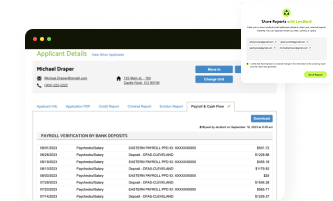
Knowing how to read your credit report is one of the most important financial skills you can build. Whether you are preparing for a rental application, applying for a loan, or simply monitoring your financial health, understanding what each section of your report means gives you a clear advantage. Every person has opened a credit file, looked at a three-digit number, and wondered what the rest of the page actually says.
A 707 with a discharged bankruptcy means something different from a 707 with a clean payment history and a six-year-old installment loan. This guide walks you through a full LeaseRunner credit report section by section, using the platform's sample applicant file. By the end, you will know what each block means, which signals matter, and how to use a full credit report to make informed decisions about your finances or your next lease application.
How To Read Your Credit Report Step By Step?
A credit report is a detailed record of a borrower's financial life. It carries five core credit report components: personal information, credit accounts report data, payment history, public records, and inquiries. Each bureau (Equifax, Experian, TransUnion) shows these slightly differently.
The LeaseRunner credit report for tenant applicants combines them into a single, clean view. For landlords, one scan reveals five years of an applicant's financial behavior. These five sections of a credit report form the foundation for reading a credit report step by step.
Step 1: Start with the credit score and score factors
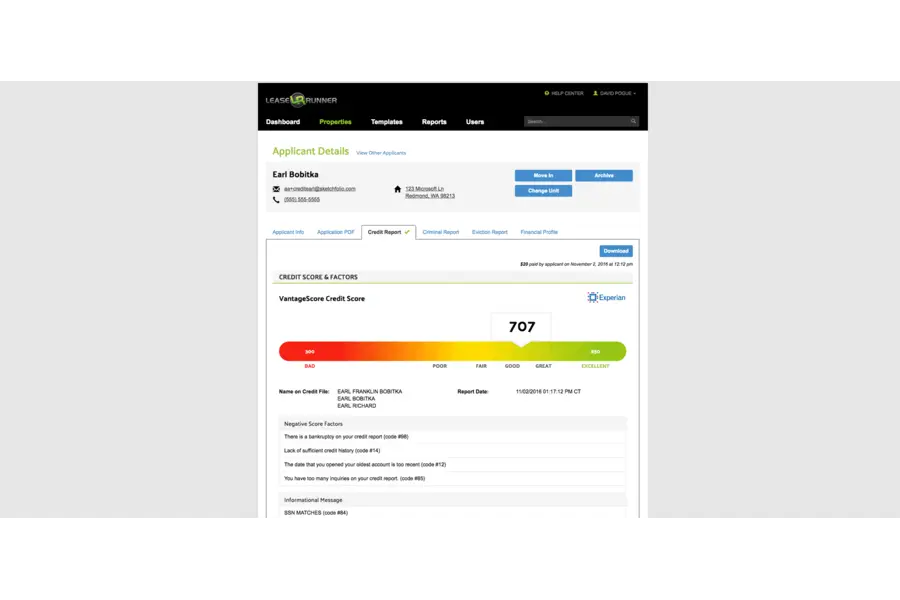
The credit score is the first number you will see, but it is the score factors underneath that reveal the real story. On the LeaseRunner sample report, the score appears as a VantageScore 3.0 of 707 from Experian on a 300 to 850 scale. What matters more is the Negative Score Factors box directly below it. The sample lists four reason codes ranked by impact:
- There is a bankruptcy on your credit report (code #98)
- Lack of sufficient credit history (code #14)
- The date that you opened your oldest account is too recent (code #12)
- You have too many inquiries on your credit report (code #85)
Each code points to a specific area holding the score back and tells you exactly where to focus. Code #14 and #12, for instance, both relate to account age. Opening and maintaining accounts over time will naturally lift these factors. Code #85 suggests pausing new credit applications for a few months. Code #98 carries the most weight here, but as you will see in Step 4, the bankruptcy's age matters just as much as its presence.
Why this matters: Two people can share the same 707 score but carry very different risk profiles. A 707 weighed down only by a thin file and an aging bankruptcy is likely to climb within 12 months of steady account use. A 707 dragged by maxed-out cards and a fresh charge-off signals deeper financial strain. The score factors make the difference visible. Start here with what factors affect a credit score.
Step 2: Review the credit summary
The credit summary compresses your entire financial picture into a single screen, making it the fastest way to gauge overall health. This section breaks your accounts into revolving tradelines (credit cards, lines of credit) and installment loans (mortgages, auto loans, student loans).
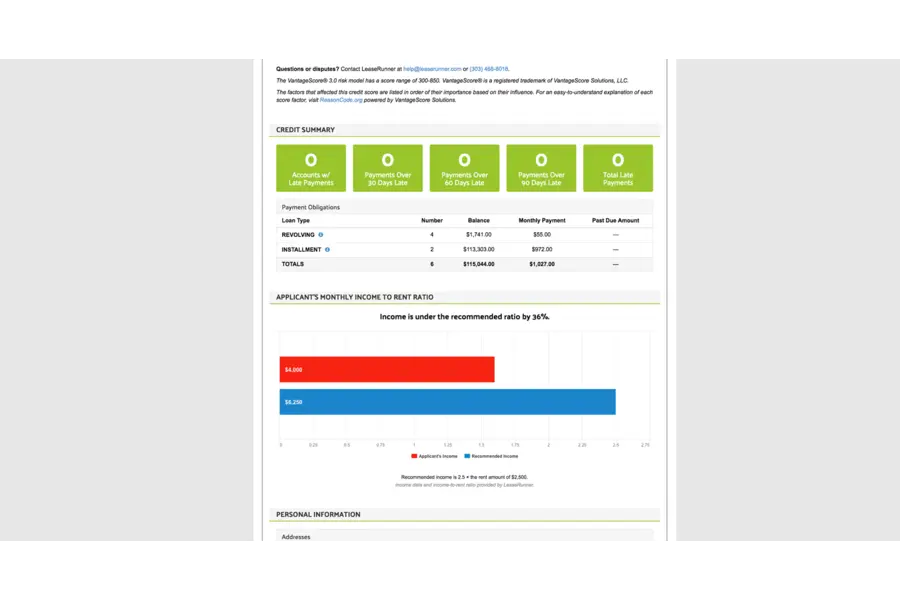
In the sample report, the Payment Obligations table shows 4 revolving accounts with a combined balance of $1,741 and monthly payments of $55, alongside 2 installment loans totaling $113,303 and monthly payments of $972. The combined monthly obligation across all 6 accounts is $1,027.
Above the table, five green summary tiles flag late payment activity. The sample shows 0 across every tile: zero accounts with late payments, zero payments over 30, 60, or 90 days late, and zero total late payments. This clean slate is one of the strongest signals on the entire report. Any red tile here is where you should stop and investigate further.
Why this matters: The summary gives you a snapshot of how balanced your credit profile is. In this sample, the $1,027 monthly obligation is already a significant commitment. If rent adds another $2,500, lenders and landlords will evaluate whether the total is manageable relative to income. A healthy mix of revolving and installment accounts with zero delinquency signals financial maturity, while heavy balances or any late payment flags are areas to address before your next application.
Step 3: Check your personal information
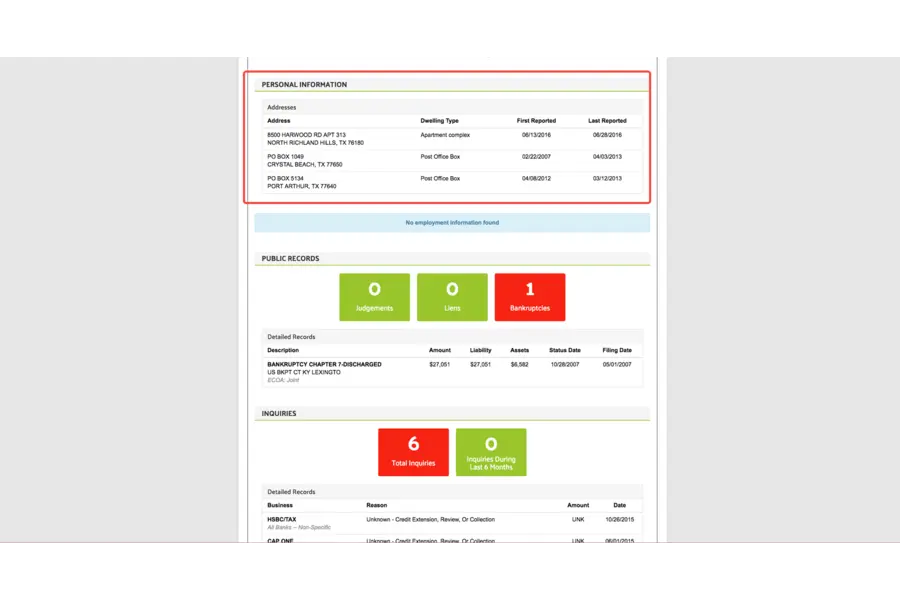
The personal information credit report block verifies identity. Landlords see the name on file, prior addresses, dwelling types, and first and last reported dates. This name, address, SSN, and credit report data are the landlord's first identity checkpoint. The sample file flags "No employment information found" when records are missing.
The personal information credit report block verifies identity. You will see the name on file, prior addresses, dwelling types, and first and last reported dates. This name, address, SSN, and credit report data are the first identity checkpoint. The sample file flags "No employment information found" when records are missing.
Why this matters: If your name is misspelled, an old address still appears as current, or employment data is missing, these details can delay rental or loan approvals. When names or addresses do not match what you provide on the credit references on the rental application, expect follow-up questions. Review this section for accuracy every time you pull your report, and dispute any outdated or incorrect entries immediately.
Step 4: Look at public records and collections
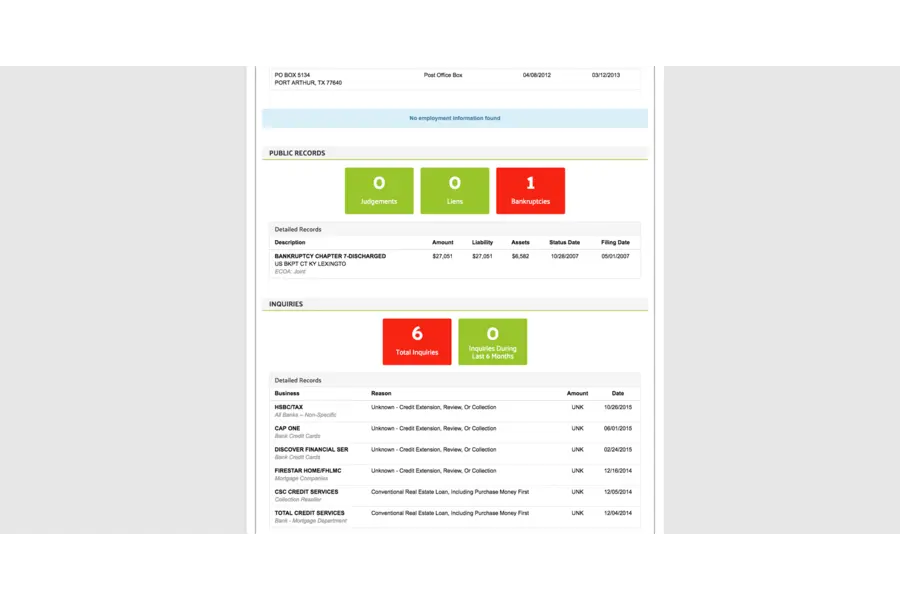
Public records carry the heaviest negative weight. The report shows counts of judgments, tax liens, and bankruptcies at the top. Each entry includes amount, liability, assets, status date, and filing date. The sample report shows 0 judgments, 0 liens, and 1 bankruptcy. The detailed record lists a Chapter 7 bankruptcy for $27,051 in liabilities and $6,582 in assets, filed on 05/01/2007 and discharged on 10/28/2007. That discharge date is roughly nine years before the report was pulled.
Why this matters: the age and status of a public record dramatically change its impact. A Chapter 7 that was discharged nine years ago is nearing the end of its reporting window. Bankruptcies typically fall off a credit report after ten years, which means the sample applicant is close to clearing this mark entirely.
Compare that to an active or recently filed bankruptcy, which carries full scoring weight and raises immediate red flags for landlords. If you see a bankruptcy on your own report, check whether it shows as "discharged" or still active, and calculate how many years remain before it ages off. That timeline helps you set realistic expectations for credit recovery and explains why your score may still be lower than your current payment habits suggest.
Step 5: Review inquiries and tradelines carefully
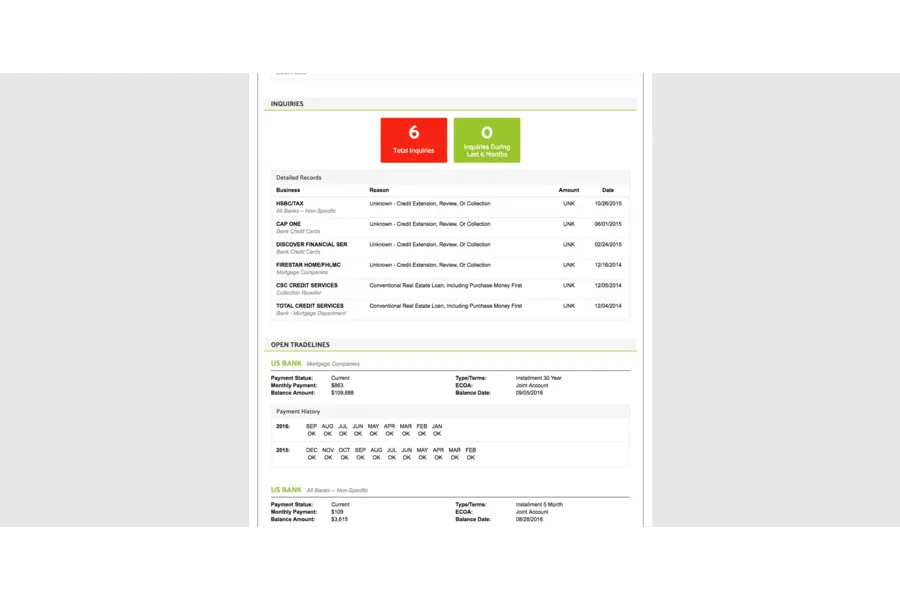
Inquiries and tradelines tell the long story. The inquiries list every company that pulled credit within the past 24 months. The sample report shows 6 total inquiries, but 0 in the last six months. All six pulls occurred between December 2014 and October 2015, from creditors such as Capital One, Discover Financial, and several mortgage-related companies. Because none fall within the most recent six months, their scoring impact has largely faded. A cluster of recent hard inquiries, by contrast, can signal financial stress to lenders and landlords, potentially lowering your score by a few points each.
Tradelines cover each account in detail: payment status, monthly payment, balance, and a 24-month payment grid. An "OK" across every month means consistent on-time payments, which is the single strongest signal of creditworthiness. Codes like "30," "60," or "90" indicate payments that were one, two, or three months late, respectively. Even a single 30-day late mark can drop your score noticeably, and a pattern of late payments raises serious concerns about repayment reliability for any future creditor or landlord reviewing your file.
This is how to read your credit report framework, which lets you finish a first pass in five minutes. Reading a credit report step by step this way beats every shortcut.
Why The Score Alone Never Tells The Full Story?
Most guides to understanding credit reports stop at the score. But the score is a symptom, and the factors behind it are the diagnosis. A VantageScore or FICO score is built from reason codes that map to specific levers: balance levels, recent activity, credit mix, account age, and late payment records. Two files at 707 can tell very different stories when one is held back by a thin file and the other by maxed-out cards.
A score is a prediction; the report is the evidence. The score moves as balances move, but the report carries the longer record of how you actually pay. LeaseRunner explains the split clearly in their piece on credit score vs credit report.
Both VantageScore and FICO score factors weigh payment history, credit utilization, length of credit history, credit mix, and new credit, though each model does the math differently.
Under the Fair Credit Reporting Act (FCRA), every consumer reporting agency pulls data from furnishers such as lenders and card issuers, and a credit report typically refreshes every 30 to 45 days as those furnishers report new balances.
How To Read The Credit Summary Section?
Understanding the summary section quickly is one of the most practical skills you can build when reviewing your credit report. How to read credit report summary data well starts here. This is the full credit report breakdown and the core credit report components that every applicant and landlord checks every time.
Total accounts and account mix
Account mix shows financial maturity. The sample lists six accounts in total: four revolving cards and two installment loans (a mortgage and a short-term loan). A balanced mix of revolving credit accounts and installment loans signals someone who manages multiple credit types. Applicants with only cards or only auto loans have a narrower credit experience.
Open accounts vs. closed accounts
Open accounts show current behavior. Closed accounts show history. Open accounts list active tradelines with live balances. Closed accounts are stored in a separate block that maintains the payment records for past cards and paid loans. Closed accounts in good standing can stay on file for up to 10 years. They quietly support the score through account age and on-time payment history.
Payments due and delinquent amounts
The 5 green tiles at the top are the fastest sanity check. The sample shows 0 accounts with late payments and 0 payments 30, 60, or 90 days late. Any red tile is where a landlord stops and reads more closely. The Past Due Amount column in Payment Obligations shows the current delinquency status. Reading a credit report payment history really is this simple: green means go, red means ask.
How To Interpret The Income-To-Rent Ratio?
The income-to-rent ratio is not a standard component of a traditional credit report as defined by the FTC or CFPB. A standard credit report covers personal information, credit history, public records, and inquiries. However, LeaseRunner adds this section as an extra layer of insight specifically designed for the rental application process.
This addition gives both tenants and landlords a clear, visual way to evaluate whether the rent amount is realistic relative to the applicant's reported income, something a generic credit report cannot provide.
A common income guideline, visualized
Many landlords and property managers use a general guideline that tenants should earn roughly 2.5 to 3 times the monthly rent, though this is a common industry benchmark rather than a fixed rule. LeaseRunner displays this as two side-by-side bars: the applicant's reported income and the recommended income based on the listed rent.
For example, if rent is $2,500, the recommended income bar might show $6,250. When the applicant's income falls significantly below the threshold, the report flags the gap as a percentage.
Why this matters for tenants: if the ratio shows a gap of 30 percent or more, landlords may request a larger security deposit, a co-signer, or a guarantor. Knowing this in advance lets you prepare documentation or alternative solutions before submitting your application. The debt-to-income ratio for an apartment should still work even with tradeline payments added.
When income looks thin
A thin ratio is not an automatic no. Strong payment history, steady work, or a guarantor can balance it out. For applicants with employment gaps, LeaseRunner's guide on getting an apartment without a job covers the documents landlords accept. Some landlords also ask for bank statements to verify cash flow. The FCRA permits this with written authorization.
When the rental history is missing
A tenant with no past lease is not automatically risky. LeaseRunner's playbook for getting an apartment with no rental history walks through the alternatives. A credit report for apartment approval is one of three pillars. The other two are income verification and references. The same document doubles as a credit report for loan or car financing in other lending contexts.
Red Flags To Look For When Reading Your Credit Report

Mastering how to read your credit report means knowing where the problems hide. Five patterns of incorrect account reporting show up most often on rental applicant files.
Accounts that the tenant does not recognize
Unknown tradelines are the clearest sign of identity fraud. A credit card that the applicant swears is not theirs, a mortgage in a different state. These trigger the dispute process under Section 611 of the FCRA. FTC dispute guide walks applicants through how to fix credit report errors for free.
Incorrect balances or payment history
Wrong balances quietly wreck utilization. A tradeline that shows $950 on a $1,000 limit when the applicant actually carries $95 looks catastrophic on paper. Fixing this kind of incorrect account reporting can lift a score 20 to 40 points in one reporting cycle.
Duplicate accounts
Duplicate accounts inflate debt totals. The same loan sometimes lists twice when it is sold between servicers. Landlords catch this by scanning account numbers and balances that look almost identical.
Unfamiliar hard inquiries
A hard inquiry the applicant did not authorize is a theft signal. A soft inquiry (such as a tenant who runs their own screening) does not affect the score. LeaseRunner provides guidance on how a tenant conducts their own screening in a dedicated guide. A hard inquiry remains visible for 24 months and affects your score for 12 months. The inquiry impact credit drag is small for one or two, heavy when five or more land in a quarter.
Public records that look inaccurate
A discharged bankruptcy shown as active is the most common public-record error. The same goes for a tenant asking about renting an apartment with a bankruptcy. Discharged filings deserve more leniency than open ones.
A stale court judgment or misfiled collections account belongs on this list, too. One often-missed entry: an old eviction routed to collections, showing up as unpaid rent. Landlords can read more on how breaking a lease hurts credit when that pattern appears.
Comparison table: severity by red flag
How To Use Your Credit Report To Improve Your Financial Profile?
If your credit report revealed areas that need work, the good news is that most issues are fixable with the right approach. Each step below builds on knowing how to read your credit report well and turns that knowledge into measurable progress.
Fix reporting errors first
Errors are the cheapest points to win. The CFPB reports that credit report inaccuracies are the number one consumer complaint year after year. A successful dispute credit report filing can improve credit scores within 30 days. That is far faster than paying down debt. The FCRA gives every consumer the right to fix credit report errors for free.
Focus on late payments and high balances
Payment history drives 35 percent of a FICO score. Late payment records and collection accounts weigh heaviest. Paying balances below 30 percent of each limit fixes the second-largest lever: credit utilization.
Tenants preparing to apply should read LeaseRunner's guide to passing a rental credit check at least 1 quarter in advance. Consistent on-time payments help build credit history and remove negative marks over time. The same logic applies to every tenant screening credit review.
Monitor inquiries and account activity
Fewer hard inquiries mean a steadier score. Three card applications in a month signal stress to scoring models. Soft pulls, including a portable tenant screening report ordered by the applicant, never affect the number. Tenants often ask if pulling their own report hurts the score. It does not. Self-pulls are soft inquiries only.
Check your report regularly
Federal law gives every consumer one free report per bureau per year at AnnualCreditReport. Tenants can track how often their credit scores update to measure progress. Credit reports refresh as furnishers report new data, usually every 30 to 45 days. Landlords running a compliant tenant credit check through LeaseRunner pull the freshest snapshot of an applicant's current standing.
Bottom Line
How you read your credit report, as LeaseRunner presents it, changes how a landlord underwrites every application. The score is the opening line, not the full sentence. The real decision sits inside the credit summary, the payment history credit report grid, the public record detail, and the income-to-rent chart.
Generic consumer reports do not even include that last piece. A landlord who walks all five steps catches identity theft, finds errors worth dozens of score points, and filters affordability risk; a single number hides. Credit reports matter to landlords because they are the most honest documents an applicant submits. Pull a test file. Walk the five steps. The next review will take half the time with twice the confidence.
FAQs
1. What should I look at first when reading my credit report?
Start with the credit score and its four reason codes. A 707 with a thin file reads very differently from a 707 with high utilization. Then scan the green-tile summary for late payment flags, move to public records, and finish with tradelines. Landlords who are asking which report to pull first should choose one with scoring reason codes attached, such as the VantageScore-powered LeaseRunner file.
2. What is the difference between open and closed tradelines?
Open accounts are live tradelines with current balances and active monthly payments. Closed accounts are paid off, settled, or closed by the creditor. Closed accounts in good standing can stay on a report for up to 10 years and support the score through age and on-time payment history. Tenants should not rush to close old cards when building credit.
3. Can landlords see public records on a tenant's credit report?
Yes. The LeaseRunner report shows judgments, tax liens, and bankruptcies in a dedicated block. The report itself is not public information. It requires a permissible purpose and written authorization under the FCRA to pull. Evictions do not appear directly on a credit report. Those come from separate court databases, which is why landlords pair them with a rental history report.
4. Why does my credit report show accounts I already closed?
Closed-in-good-standing accounts stay for up to 10 years by design. The payment history supports the score. If an account the applicant closed shows as "closed by grantor" instead, that needs a dispute. Landlords comparing bureaus will notice each one can show different closed-account data. LeaseRunner pulls the cleanest available snapshot from Experian.
Disclaimer: The information provided in this post is intended for general informational and educational purposes only. It should not be construed as legal, accounting, or tax advice. For guidance specific to your situation, we recommend consulting with a qualified professional in the relevant field before taking any action based on the content provided.