This tenant screening guide starts with a hard truth: one wrong signature can cost a landlord thousands. Picture a unit filled fast, no questions asked. Three quiet months follow, during which the rent should be. Then comes a court date and a wrecked apartment. That story repeats across the U.S. every week.
Careful landlords avoid it by vetting every prospective tenant through the same steady routine. This guide covers what tenant screening is, the laws that shape it, and the exact path from application to approval. LeaseRunner built its platform around that exact workflow, and thousands of owners already rely on this same tenant-screening process week after week.
What Is Tenant Screening?
Tenant screening is the process of checking a rental applicant against a written standard to judge how they will handle the lease. The core parts are a credit report, a criminal background check, an eviction history search, income verification, and a look at prior rental history. The depth changes with the property. A single room may need a light check, while a family home warrants a full screening report. Say two people apply for the same duplex.
One shows steady pay stubs and clean references; the other has a recent eviction and thin documentation. Screening turns that gut feeling into evidence. In practice, tenant screening means a landlord makes a decision based on facts, not a hunch, and can point to a clear tenant screening report if the choice is ever questioned. LeaseRunner packages these checks into a single dashboard, so the full picture appears in minutes. So how does tenant screening work in practice? It runs through six fixed steps, from a pre-screening questionnaire to a documented approval, and the rest of this guide walks through each one.
Overall, landlords should treat screening as a repeatable system, not a favor granted on a case-by-case basis. The system is what protects the property and the profit.
Why Tenant Screening Matters for Landlords?
Tenant screening for landlords is really a risk assessment on the biggest line item in the business: the person paying the rent, and this guide puts real numbers behind that risk. The math makes the case.
An eviction is expensive and slow. TransUnion research puts the average cost of an eviction near $3,500 per unit, and that figure climbs once property damage, lost rent, and legal fees stack up. The same analysis found evicted residents carry roughly three times as many prior eviction and collection records as those who stay in good standing.
That gap is exactly what screening surfaces before a lease is signed. Skipping it invites payment default, longer vacancy, and costly turnover between tenants. A thorough check also reduces the odds of renting to someone who damages the unit or breaks the lease. For the price of one screening report, a landlord can weed out the applicant who would have triggered a four-figure loss.
In short, tenant screening is not a cost, it is insurance. Spending $20 to $60 up front beats absorbing a $3,500 eviction cost later.
Fair Housing Laws Every Landlord Must Follow When Screening
Tenant screening laws set the boundaries for the whole process, and breaking them is far more expensive than any bad tenant. Fair housing-compliant tenant screening rests on two federal pillars plus a growing web of state rules, and this screening guide walks through each.
The Seven Federally Protected Classes
The Fair Housing Act bars discrimination in housing decisions, and it names specific groups a landlord may never screen against. Fairness here is not optional; it is the law.
The 7 federally protected classes are:
- Race, which cannot factor into any approval or denial.
- Color, a separate class covering skin tone and complexion, including distinctions drawn within the same race.
- National origin, including where an applicant or their family comes from.
- Religion, meaning no preference or bar based on faith.
- Sex, which courts read to include gender identity and sexual orientation.
- Familial status, protecting households with children under 18.
- Disability, which also requires reasonable accommodations.
Consistency is the defense. When a landlord applies the same objective criteria to every prospective tenant, non-discrimination becomes the default rather than an effort. LeaseRunner keeps a written trail of each request, which supports an even-handed record.
Written Consent and Permissible Purpose
Before pulling any report, a landlord needs a legal reason and the applicant's permission. This is where the FCRA (Fair Credit Reporting Act) comes into play.
Under the FCRA, a tenant screening report is a consumer report, so a landlord must have written authorization from the applicant and a permissible purpose before ordering it, a duty the FTC spells out in its consumer report guidance for landlords. LeaseRunner handles consent inside the application flow, and the applicant enters their own Social Security details, so the landlord never touches that sensitive data. That single design choice lowers the landlord's liability and keeps the file clean.
HUD Guidelines on Using Criminal History in Screening
In late 2025, HUD reversed that stance in its 2025 criminal-screening letter, but the letter speaks directly to public housing authorities and owners of HUD-assisted housing, not private market-rate landlords. A private landlord operating outside HUD programs is not bound by that letter and should still apply an individualized review to any conviction.
State and Local Screening Laws
Federal law is the floor, not the ceiling. State and city rules often add tougher limits, and they vary widely. 3 fast-growing categories matter most. Source-of-income laws in many states bar landlords from rejecting housing vouchers. Ban-the-Box and "fair chance" ordinances delay or restrict the timing of criminal history review.
A growing number of states now recognize the portable tenant screening report, allowing renters to reuse a single report across listings. LeaseRunner already supports these reusable screening reports in states that allow them, and its reports automatically adjust to local record rules.
Every landlords should learn the compliance rules for the exact city where the property sits, because a legal misstep dwarfs the cost of any single vacancy.
How to Set Your Tenant Screening Criteria (Income, Credit, Rental History)?
Strong rental criteria written down before the listing goes live keeps the whole tenant screening process fair and fast. This stage of the tenant screening guide focuses on the standard itself, which is applied consistently to every applicant.
A clear, defensible set of rental criteria usually covers:
- Income: Most landlords apply the 3x-rent rule, meaning a verified monthly income of at least 3x the rent.
- Credit: a minimum credit score floor, often in the 600 to 650 range, with room for context.
- Rental history: a pattern of on-time rent and no unresolved eviction records.
- Background: a criminal background check reviewed by conviction type and recency, not a blanket rule.
- Documentation: a complete rental application, pay stubs, and reachable references.
Putting these in writing sets the same bar for every prospective tenant. LeaseRunner's tenant screening checklist helps landlords lock in criteria before applications arrive. It would be best to decide the standard first, then measure applicants against it. Criteria set after reading an application invites bias and legal trouble.
The Tenant Screening Process: 6 Steps From Application to Approval
The tenant screening process for rental property works best when followed in a fixed sequence. These tenant screening steps move an applicant from first contact to a signed lease without guesswork and form the backbone of this tenant screening guide.
1. Pre-Screen Applicants Before the Showing
A short pre-screening questionnaire saves hours by filtering out clear mismatches early. It happens before anyone tours the unit.
Basic pre-screening asks about move-in date, income range, pets, and reason for moving. These are legal, neutral questions tied to qualifications, never to a protected class. LeaseRunner's list of questions to ask tenants keeps this step compliant and consistent.
2. Collect the Completed Application Form
The rental application is the backbone of the file. Every applicant fills out the same form. A solid application captures identity, employment, income sources, prior addresses, and references. It also collects the written authorization needed to run reports. A consistent form makes side-by-side comparison simple and fair.
3. Verify Income and Financial Stability
Income verification confirms the applicant can actually afford the rent. This step catches the most common cause of default.
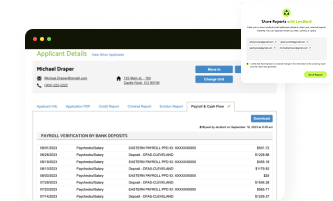
Landlords typically request recent pay stubs, tax returns, or bank statements to apply the 3x rent rule. LeaseRunner adds a cash-flow report that reads real deposits, and its guide on how to verify tenant income covers self-employed cases. When income falls short, a co-signer or guarantor can bridge the gap where local law allows.
4. Run Credit, Background, and Eviction Reports
This is the heart of the screening report. Three checks run together for a full financial and legal picture.
The credit report shows payment habits and debt load, the criminal background check flags safety concerns, and the eviction history search reveals past disputes. LeaseRunner pulls Experian data and searches millions of eviction records nationwide, delivering all three to one dashboard in minutes.
5. Check References Thoroughly
A quick call to a prior landlord adds context that no report can. This human step confirms the paper trail.
A landlord reference reveals whether rent was paid on time, whether the unit was kept in good condition, and whether the lease was honored. Speaking to the previous landlord, not the current one, cuts the risk of a biased "please take them" review.
6. Issue the Official Approval and Request the Deposit
The final step turns a decision into a signed lease. Timing and notice matter here.
On approval, the landlord sends the lease agreement and requests the security deposit to hold the unit. On denial, the applicant deserves prompt, neutral notice. If a report drove the choice, an adverse action letter is required. A careful landlord runs the same six steps for tenant screening every time. Consistency is both the fairest method and the strongest legal shield.
Credit, Background & Eviction Checks Explained
These three reports form the core of any tenant screening report, and each answers a different question about the applicant. Reading them well is where good landlords separate real risk from noise, so this part of the tenant screening guide explains each one.
Credit Check
A credit check measures how an applicant manages money over time. It is the clearest signal of future rent reliability. There is no legal minimum, but many landlords sort applicants into credit score tiers to stay consistent:
An applicant in the fair tier can still qualify with a larger security deposit or a co-signer, where state law allows the increase. The tier sets the starting point; the full file sets the decision. LeaseRunner reports an Experian-based credit score plus its own tenant risk model. Its breakdown of what landlords look for in a credit check explains how to read the tradelines behind the number.
Criminal Background Check
A criminal background check supports resident safety, but it requires careful handling under fair housing rules. Context beats a blanket ban.
A landlord should weigh the type of offense, its severity, and how long ago it happened. Arrests without conviction carry little weight, whereas recent violent convictions carry more weight. LeaseRunner runs a nationwide search across all 50 states and Washington, D.C., down to the county court level, and its list of red flags in background checks shows what truly signals risk.
Eviction History Check
An eviction history search is the single best predictor of a repeat problem. Past behavior tends to forecast future behavior.
The report shows prior filings, judgments, and amounts owed. A recent eviction for nonpayment is a serious warning, though an old, resolved case may deserve a conversation. LeaseRunner searches millions of court eviction records nationwide, and its guide to check eviction history explains how to read a judgment.
What this means for landlords: never rely on a single report. Credit, background, and eviction data together tell the story that any single check would miss.
Best Tenant Screening Tools and Services Compared

The right platform turns a slow, manual chore into a same-day decision, and this is where the tenant screening guide gets practical. AI screening tools and modern dashboards now handle the heavy lifting, and they fold compliance into the workflow. AI screening tools now flag doctored pay stubs, mismatched deposits, and income inconsistencies automatically, work that once took a landlord hours of manual review. The landlord still owns the final call, though, and fair housing rules apply to an algorithm's output the same way they apply to a human decision.
LeaseRunner was built by landlords for landlords, with a pay-per-use model and no monthly fees. It bundles credit, criminal, eviction, and income reports, and lets the applicant cover the application fee where state fee caps allow. The tiers below show how the package scales:
Because applicants can pay, many landlords screen at little or no cost to themselves. A pay-per-use model can also cost less than a monthly subscription for owners who screen only a few units a year. For a full breakdown of fees and caps, see LeaseRunner's guide on how much tenant screening costs.
What this means for landlords: pick a tool that scales with volume and keeps sensitive data out of landlords' hands. Fewer manual steps mean faster approvals and lower liability.
7 Common Tenant Screening Mistakes That Get Landlords Sued
Most fair housing complaints trace back to a handful of avoidable errors. This screening guide ends with the how-to and the traps to skip, because following tenant screening best practices keeps a landlord clear of court.
The seven mistakes that draw lawsuits are:
- Applying uneven standards. Screening one applicant harder than another breaks the rule of consistency.
- Asking illegal questions. Anything that touches on a protected class, such as medical conditions or national origin, is off-limits.
- Skipping written consent. Pulling a report without written authorization violates the FCRA.
- Using blanket criminal bans. Rejecting every record ignores the individualized review courts expect.
- Charging unlawful fees. An application fee above state fee caps invites penalties.
- Denying with no notice. Every denial based on a report requires an adverse action letter. LeaseRunner's guide on what to include in an adverse action letter covers the required parts, and the CFPB's written-notice guidance explains why it must be in writing.
- Poor documentation. Without records, a landlord cannot prove fair treatment. Keeping notes on valid reasons to deny a rental application builds that defense.
A single dashboard reduces these risks by standardizing every step. LeaseRunner's tenant background screening keeps consent, reports, and notices within a single compliant workflow.
What this means for landlords: the lawsuit rarely comes from the report itself. It comes from an inconsistent or undocumented decision, and a system fixes both.
Conclusion
Treat this as your ultimate guide to tenant screening, and it comes down to one habit: judge every prospective tenant by the same written standard, backed by real reports. The path is simple to repeat, from a pre-screening questionnaire through income verification, credit, criminal, and eviction history checks, to a documented approval or a proper adverse action letter.
Skipping steps is what invites a $3,500 eviction or a fair housing claim. Doing them well fills units with renters who pay on time and stay. LeaseRunner turns that entire routine into a few clicks, with compliant reports delivered in minutes. Solid tenant screening is the cheapest insurance a rental business will ever buy.
FAQs
1. How long does tenant screening take?
Most reports return fast. LeaseRunner delivers credit, criminal, and eviction results to the dashboard within minutes by pulling directly from national records. Manual steps add time.
Contacting a landlord reference or verifying self-employed income can extend the process by a day or two. See LeaseRunner's guide on how long tenant screening takes for a step-by-step timeline.
2. How much does tenant screening cost?
Screening usually runs $17 to $64 per applicant, depending on which reports are bundled. Many landlords pass the application fee to the renter, so the cost to the owner drops to zero. State fee caps limit how much a landlord may charge, so the fee should match the actual cost of the report.
3. What credit score do you need to pass tenant screening?
There is no legal minimum. Many landlords set a floor between 600 and 650 and read the score alongside income and rental history. An applicant below that line can still qualify with strong pay stubs, a clean record, or a co-signer. The credit score is one input, not the whole decision.
4. Can a landlord deny an applicant based on criminal history?
Yes, but with limits. A record is not a protected class, so criminal history may factor into a decision. Under fair housing principles, a landlord should weigh the type, severity, and age of the offense rather than apply a blanket ban. Arrests without conviction should not drive a denial.
5. What's the difference between a credit check and a full tenant screening report?
A credit check is one data point: it shows debt and payment history. A full tenant screening report bundles that credit data with a criminal background check, an eviction history search, income verification, and identity checks. The full report gives the complete risk assessment; a credit check alone tells only part of the story. LeaseRunner explains the difference in its overview of a tenant screening report.
Disclaimer: The information provided in this post is intended for general informational and educational purposes only. It should not be construed as legal, accounting, or tax advice. For guidance specific to your situation, we recommend consulting with a qualified professional in the relevant field before taking any action based on the content provided.